Chu Dong Tu is one of Vietnam (베트남 / 越南 / ベトナム)'s Four Immortals, and his shrine complex in Hung Yen province is where locals have honored that legend for centuries. For travelers, it's a half-day trip into the Red River Delta that most foreign visitors never make — which is exactly why it's worth going.
What it is
Khu Di Tich Chu Dong Tu is a cluster of temples and shrines spread across Binh Minh commune in Khoai Chau district, about 25 km south of Hung Yen city. The complex centers on Den Chu Dong Tu (the main temple), along with Den Da Hoa and several smaller shrines dotting the riverbank.
The legend: Chu Dong Tu was a fisherman so poor he shared a single loincloth with his father. He met Princess Tien Dung while she was bathing on the riverbank — a chance encounter that became one of Vietnam's oldest love stories. The temples here mark where they supposedly lived, traded, and eventually ascended to heaven.
Historically, the site dates back over a thousand years, though the current structures are restorations from the Nguyen dynasty era and more recent renovations. The main temple sits on raised ground overlooking rice paddies and the Day River — flat, green, and quiet.
Why travelers go
Three reasons. First, the annual festival (lunar February) draws enormous crowds and is one of the largest folk festivals in the north — a genuine spectacle of processions, boat races, and rituals that hasn't been sanitized for tourists. Second, the architecture blends Vietnamese communal-house style with Buddhist and Taoist elements in ways you don't see in Hanoi's more famous temples like Tran Quoc Pagoda or the Temple of Literature. Third, it's a window into Red River Delta village life that you simply can't get from a Hanoi day trip to Ninh Binh (닌빈 / 宁平 / ニンビン).
Best time to visit
The festival runs from the 10th to 12th of the second lunar month (usually March). Go on the 11th for the main procession — palanquins carried through the village, "hat van" singing, and offerings floated on the river. It's crowded and loud and genuinely exciting.
Outside festival time, October through December is ideal. The air is cool, skies are clear, and the surrounding paddies shift between harvest gold and fresh green. Avoid June-August: the heat is brutal on exposed temple grounds with minimal shade, and afternoon rain makes the unpaved paths muddy.
How to get there from Hanoi
The site is roughly 70 km southeast of central Hanoi. Options:
- Motorbike: The most practical choice. Take National Road 39 south through Hung Yen city, then cut west toward Khoai Chau. About 1.5-2 hours depending on traffic through the Hanoi suburbs. Fuel cost around 50,000-70,000 VND round trip.
- Bus + xe om: Catch a bus from Giap Bat station to Hung Yen city (60,000-80,000 VND, 1.5 hours), then hire a xe om (motorbike taxi) for the remaining 25 km to Binh Minh commune — negotiate around 100,000-150,000 VND one way.
- Grab car: From Hanoi center, expect 400,000-500,000 VND one way. Harder to get a return ride from the site, so consider booking a round trip.
There's no direct public transport to the temple complex itself. The last 5 km from the main road is narrow village lanes.

Photo by Quang Nguyen Vinh on Pexels
What to do
Walk the main temple compound
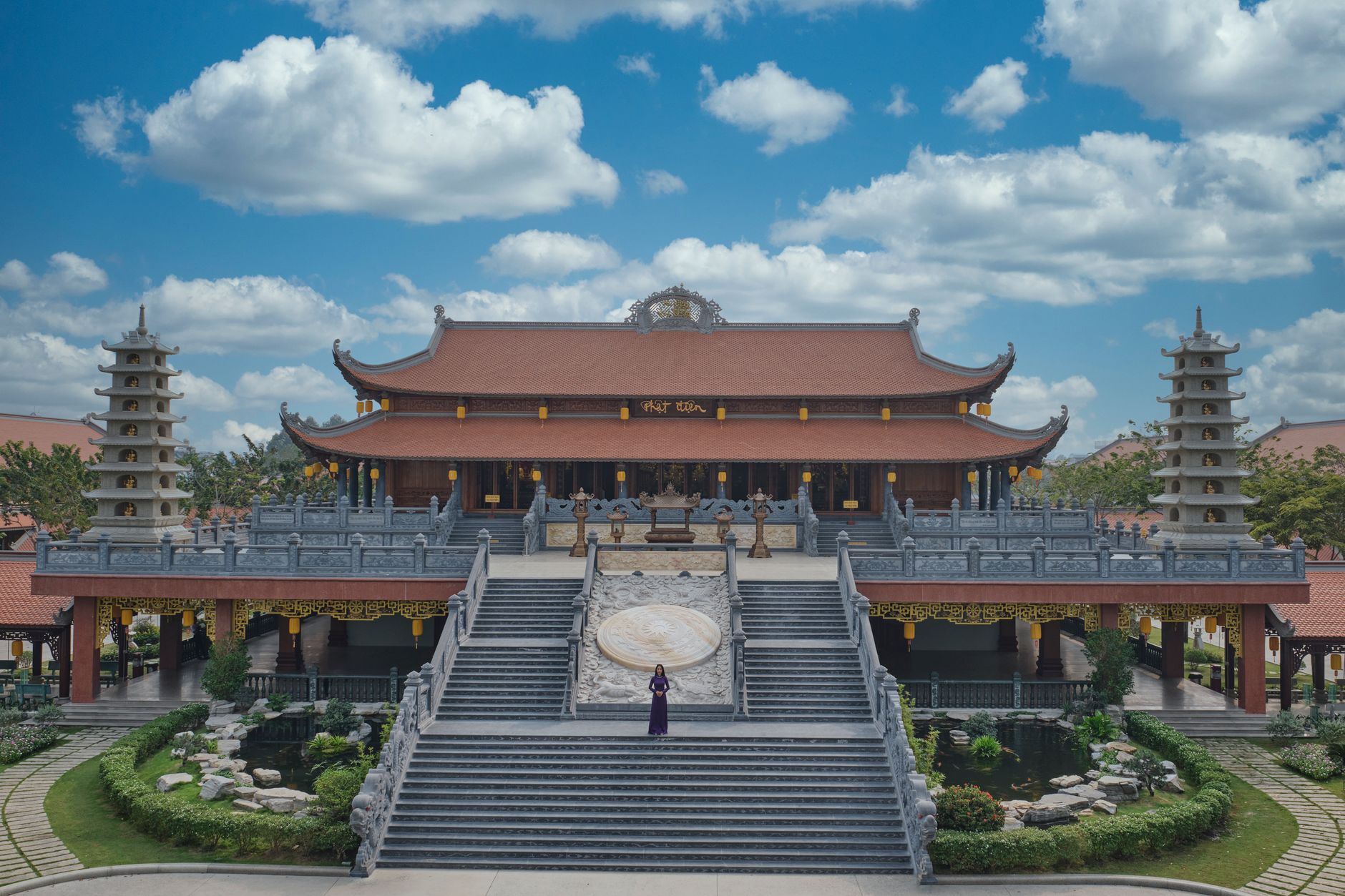
Den Chu Dong Tu has a classic three-chamber layout: the outer worship hall, the middle hall with incense burners, and the inner sanctum where the statues of Chu Dong Tu and Tien Dung sit. Pay attention to the carved wooden panels — they depict scenes from the legend with surprising detail. Entry is free; donations are expected (20,000-50,000 VND is standard).
Visit Den Da Hoa
About 1 km from the main temple, this smaller shrine marks where the couple supposedly ascended. It's quieter, less visited, and has a large banyan tree that's become a local landmark. The walk between temples goes through village paths lined with longan orchards.
Explore the riverbank
The Day River section near the complex is where fishing boats still dock. Early morning or late afternoon, you can watch small-scale net fishing that hasn't changed much in decades. During festival time, this is where the boat races happen.
Attend a ritual (festival period)
If you're here during the festival, don't miss the "hat van" spirit-medium ceremony held inside the temple. It's a form of trance singing connected to the Mother Goddess religion — rhythmic, intense, and visually striking with elaborate costumes.
Cycle the surrounding villages
Bring or rent a bicycle and ride through Khoai Chau's back roads. The area is known for longan fruit (August harvest) and traditional incense-making villages. Flat terrain, minimal traffic once you're off the main road.
Where to eat nearby
The area around the temple has basic com binh dan (rice-and-dish stalls) serving standard northern fare for 30,000-50,000 VND per meal.
For something specific to the region, look for "banh cuon" — steamed rice rolls filled with minced pork and wood-ear mushroom. Hung Yen's version uses a slightly thicker wrapper than Hanoi's. Stalls along the road into Khoai Chau town serve it in the morning.
Also worth trying: "nhan long" (dried longan) as a snack — Hung Yen is the longan capital of the north, and roadside vendors sell bags for 80,000-120,000 VND per kilogram.
Where to stay
There's no tourist accommodation at the temple site itself. Your options:
- Hung Yen city (25 km): Basic hotels and nha nghi (guesthouses) from 200,000-400,000 VND/night. Nothing fancy, but clean enough. A few mid-range options around 500,000-700,000 VND with air conditioning and breakfast.
- Return to Hanoi: Most visitors treat this as a day trip, which is realistic if you leave early.
- Homestays in Khoai Chau: A few families offer rooms during festival season. Ask at the temple management office — they sometimes coordinate. Expect 150,000-250,000 VND.

Photo by HONG SON on Pexels
Practical tips locals would tell you
- Dress modestly at the temples. Covered shoulders and knees — this is actively enforced during festival time.
- Bring cash. There are no ATMs near the site, and the nearest bank branch is in Khoai Chau town center.
- If visiting during the festival, arrive before 7 AM to secure parking and a decent viewing spot for the procession. By 9 AM, the roads are gridlocked with motorbikes.
- The temple grounds close around 5 PM outside festival periods. No evening visits.
- Vietnamese egg coffee or ca phe sua da won't be found here — it's green tea from a thermos at the temple, or instant coffee from a roadside stall.
Common mistakes to avoid
- Coming without cash: You'll need small bills for parking (5,000-10,000 VND), donations, incense, and food stalls. Nothing takes cards.
- Underestimating travel time: Google Maps says 1.5 hours from Hanoi, but the village roads in the final stretch are slow. Budget 2 hours minimum.
- Skipping Den Da Hoa: Most visitors only see the main temple and leave. The secondary shrine is quieter and arguably more atmospheric.
- Visiting midday in summer: No shade, concrete paths that radiate heat, and all the food stalls close between 11 AM and 2 PM. Go early or late.
Practical notes
This isn't a polished tourist attraction — it's a working religious site in a farming district. That's the appeal. Come with patience, small bills, and a willingness to navigate without English signage, and you'll see a side of northern Vietnam that the standard Hanoi-Ha Long-Ninh Binh circuit completely misses.
Last updated · May 29, 2026 · independently researched, never sponsored.