Song Huong — the Perfume River — is the reason Hue exists where it does. The Nguyen lords built their capital along its banks in the 17th century, and the river still defines the city's geography, its mood, and the way people move through it. If you spend any time in Hue, you'll cross it, eat beside it, and probably end up on a boat somewhere along its 80-km stretch from the Truong Son mountains to the Tam Giang lagoon.
What it is and why it matters
Song Huong runs roughly west to east through Hue (후에 / 顺化 / フエ), splitting the city into two halves. The north bank holds the Imperial Citadel and the older residential quarters. The south bank is where most hotels, restaurants, and backpacker streets sit. Seven bridges connect the two sides, with Truong Tien Bridge — a Gustave Eiffel-era steel span built in 1899 — being the most recognizable.
The name "Perfume River" supposedly comes from flowers that fall into the water upstream during autumn, though locals will tell you the scent is more subtle than the name suggests. What isn't subtle is how central the river is to daily life here: morning exercise along the banks, afternoon fishing from the bridges, evening food stalls lining the waterfront.
Why travelers go
Hue's major sights are strung along Song Huong like beads on a wire. The Tomb of Tu Duc, the Tomb of Khai Dinh, and Thien Mu Pagoda all sit on or near the riverbanks upstream from the city center. A boat ride is one of the most practical — not just scenic — ways to reach them. The river also gives Hue its particular atmosphere: slower, greener, quieter than Hanoi (하노이 / 河内 / ハノイ) or Saigon. It's the kind of place where sitting on a plastic chair watching the water for an hour doesn't feel like wasted time.
Best time to visit
Hue's weather is its own thing. The city sits in a climate pocket that doesn't neatly match the rest of central Vietnam.
- February to April is the sweet spot. Dry, mild (22-28°C), and the river runs calm and green. March is arguably the best single month.
- May to August is hot — often 35°C+ — but clear. Early morning and late afternoon on the river are still pleasant. Midday is brutal.
- September to December brings the rain. Hue gets hammered by monsoons, especially October and November. The river floods regularly, sometimes badly. Streets near the banks go underwater. Travel is possible but plan for disruptions.
If you have flexibility, aim for March or early April.

Photo by Pew Nguyen on Pexels
How to get there
Hue has its own airport (Phu Bai, airport code HUI), about 15 km south of the city center. Flights from Hanoi run about 1 hour 10 minutes (600,000-1,200,000 VND one way on VietJet or Bamboo). From Saigon, roughly 1 hour 20 minutes at similar prices.
From Da Nang — the nearest major hub — you have options:
- Train: 2.5-3 hours, 60,000-120,000 VND for a hard seat. The route follows the coast and crosses the Hai Van Pass, which is genuinely one of the better train rides in Vietnam.
- Bus: 2-3 hours, 100,000-150,000 VND. Frequent departures from Da Nang bus station.
- Grab car: Around 900,000-1,100,000 VND, 2 hours door to door.
Once in Hue, Song Huong is impossible to miss. Walk 10 minutes in any direction from the tourist area and you'll hit it.
What to do
Take a dragon boat upstream
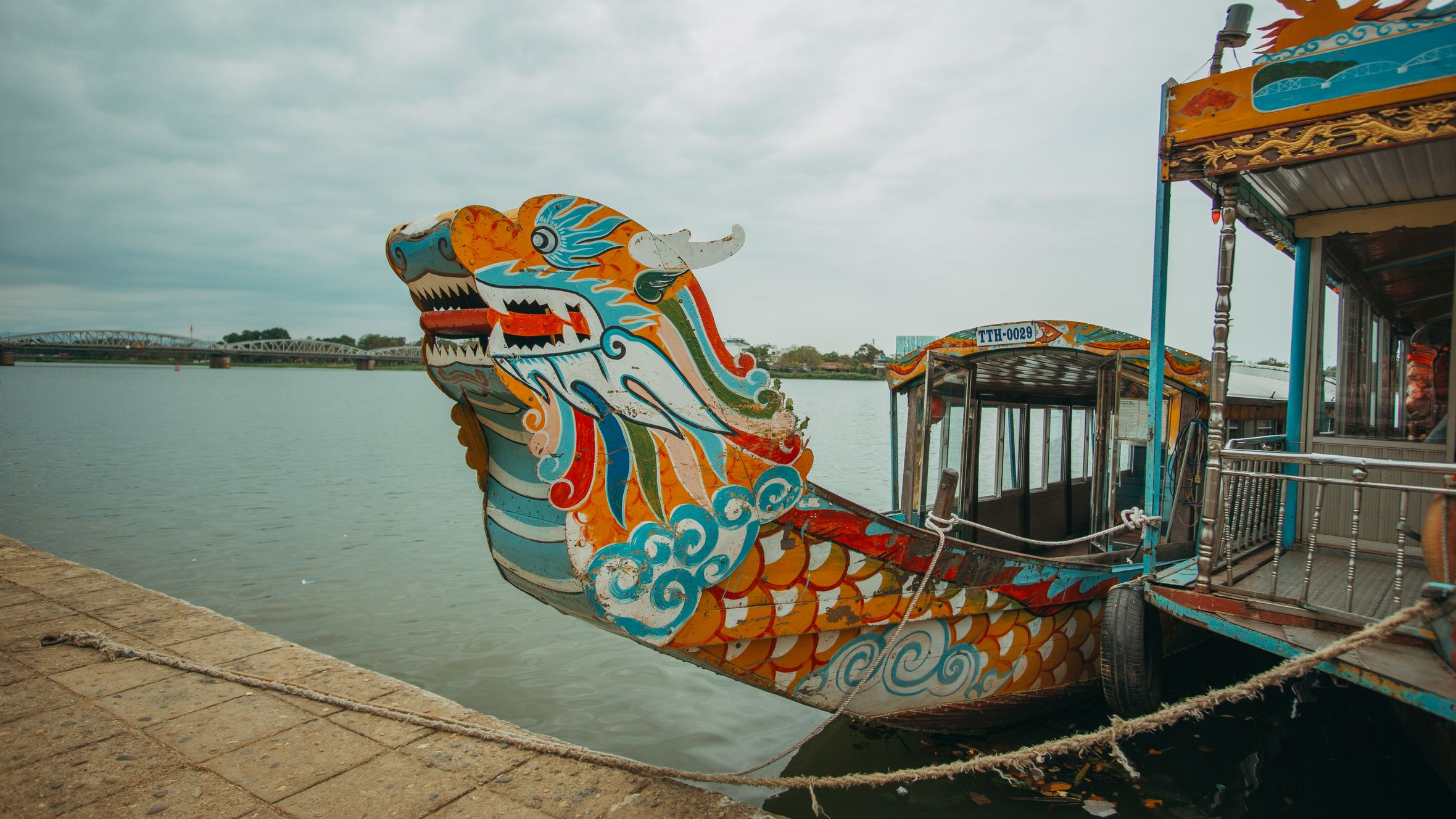
The classic Song Huong experience. Shared tourist boats leave from the pier near Toa Kham (south bank, near Truong Tien Bridge) and head upstream to Thien Mu Pagoda, about 5 km west. A shared boat runs 80,000-100,000 VND per person. Private hire for a half-day — covering Thien Mu plus one or two royal tombs — costs 400,000-600,000 VND for the whole boat (fits 4-6 people). Negotiate before boarding, not after.
Walk the north bank at sunset
The stretch between Truong Tien Bridge and Phu Xuan Bridge on the Citadel side has a paved promenade that fills up around 5-6 PM. Locals jog, families set up picnic mats, vendors sell "che" (sweet soup) from carts. It's low-key and unstructured — exactly the point.
Cross Truong Tien Bridge on foot at night
The bridge lights up in rotating colors after dark (the LED installation is relatively new and a bit garish, honestly, but it's become a Hue landmark). The real draw is the view up and down the river, with boats lit by lanterns drifting below. Best around 7:30-8:30 PM.
Visit Thien Mu Pagoda
Hue's most famous pagoda sits on a hill overlooking the river about 5 km west of the center. The seven-story octagonal tower dates to 1844. It's an active Buddhist monastery, so dress appropriately — covered shoulders and knees. Free entry. You can arrive by boat (see above) and grab a Grab bike back, or vice versa.
Cycle along the south bank to Vong Canh Hill
Rent a bicycle (40,000-60,000 VND/day from most guesthouses) and ride west along the south bank road past Kim Long neighborhood. After about 7 km you'll reach Vong Canh Hill, a quiet overlook above a bend in the river. Not many tourists make it here. Bring water.
Where to eat nearby
Hue is arguably the best food city in Vietnam, and the riverside area doesn't disappoint.
"Bun bo Hue" is the signature dish — a spicy, lemongrass-heavy beef and pork noodle soup that's more complex than pho. Try it at Bun Bo Hue Ba Tuyet on Nguyen Du Street, south bank. A bowl runs 30,000-40,000 VND.
For "banh canh" — thick tapioca noodles in a pork-and-crab broth — the cluster of street stalls on Pham Hong Thai near the river is reliable. Expect 25,000-35,000 VND.
The riverside stretch of Le Loi Street has more upscale restaurants with terrace seating over the water. Prices jump to 150,000-300,000 VND per dish, but the setting earns it on a calm evening.

Photo by Quang Nguyen Vinh on Pexels
Where to stay
- Budget: Guesthouses on Pham Ngu Lao or Le Loi streets, south bank. 200,000-400,000 VND/night for a clean room with AC.
- Mid-range: Boutique hotels on the south bank with river-facing rooms. 800,000-1,500,000 VND/night. Worth asking specifically for a river view — the price difference is often small.
- High-end: A few resorts sit along the river west of the center, toward the tombs. 2,500,000-5,000,000 VND/night. Quiet, but you'll need transport into town.
Practical tips
- The river looks calm but has a current, especially after rain. Don't swim in it — locals don't either.
- Boat operators along the tourist pier will quote inflated prices. Walk 50 meters in either direction and prices drop. Or just agree on a number beforehand.
- Bring a hat and sunscreen for any daytime river activity. There's almost no shade on the boats.
- If you're visiting royal tombs by boat, confirm whether the boat waits for you or if you need to arrange separate transport back. Getting stranded at the Tomb of Tu Duc without a ride is a common rookie mistake.
- The evening floating-restaurant boats that serve dinner with live "ca tru" music are a tourist setup — overpriced food, mediocre performance. Skip it unless you specifically want the kitschy experience.
Common mistakes
- Only seeing the river from a car window. You need to be on or beside the water to get what makes Hue different from other Vietnamese cities.
- Visiting in November without rain gear. Hue floods are not hypothetical. Check forecasts.
- Skipping the north bank. Most tourists stay south and taxi to the Citadel. The neighborhoods north of the river — quieter, more residential, better street food — are worth a half-day wander.
Last updated · May 29, 2026 · independently researched, never sponsored.