The Mekong Delta (메콩 델타 / 湄公河三角洲 / メコンデルタ) doesn't get much tourist traffic south of Can Tho, which is exactly why a place like Phat Ba Nam Hai feels so different from the usual circuit. This is a giant statue of the Bodhisattva Avalokitesvara — 73 meters tall on a lotus pedestal — planted on the southern coast of Ca Mau province, facing the East Sea. It draws hundreds of thousands of Vietnamese pilgrims a year but barely registers with foreign visitors.
What it is and how it got here
Phat Ba Nam Hai (formally Quan Am Phat Dai) is a religious complex centered around one of the tallest standing Buddhist statues in Southeast Asia. The site sits in Dat Mui commune, Ngoc Hien district, near the southern tip of the Vietnamese mainland. Construction began in 2010 and the statue was completed around 2014, built largely through donations from Buddhist communities across the delta.
The complex covers roughly 12 hectares. Beyond the main statue, there's a large temple hall, a bell tower, landscaped gardens with smaller bodhisattva figures, and a long reflecting pool that lines the approach path. The whole place is oriented toward the sea, and on clear days the statue is visible from several kilometers out along the coastal road.
This site was formerly administered under Bac Lieu province before regional boundary changes placed it within Ca Mau. You'll still find older maps and some Vietnamese travel sites listing it under Bac Lieu — don't be confused, it's the same place.
Why travelers go
Most foreign visitors who end up here are already doing a deep Mekong Delta loop — the kind that pushes past Can Tho (껀터 / 芹苴 / カントー) and into the mangrove country around Ca Mau Cape. Phat Ba Nam Hai works as a stop along that route, and it offers something you genuinely don't see elsewhere in the delta: scale. The statue is enormous, visible long before you arrive, and the complex around it is kept surprisingly well-maintained given how remote it feels.
For photographers, the late afternoon light hitting the white statue against delta sky is worth the detour alone. For anyone interested in how contemporary Buddhism expresses itself in southern Vietnam, the site is a fascinating case study — this isn't ancient heritage, it's living, active, heavily visited religious architecture built within the last fifteen years.
Best time to visit
The dry season — roughly December through April — is the clear winner. The delta's wet season (May–November) turns the roads muddy and the humidity oppressive, though the complex itself stays open year-round.
If you time it for [Lunar New Year](/posts/tet / 越南春节 / テト)-lunar-new-year-guide) (Tet) or the Quan Am festival days (19th of the 2nd, 6th, and 9th lunar months), you'll see the site at its most intense — packed with pilgrims, incense smoke, and ceremony. It's chaotic but genuinely atmospheric. Outside of festival dates, weekday mornings are quiet.
How to get there
The nearest major hub is Ca Mau city, roughly 100 km north of the statue.
- From Ca Mau city: Hire a motorbike taxi or rent your own bike. The ride takes about 2–2.5 hours via Highway 1 south through Nam Can, then east toward Dat Mui. Cost for a "xe om" (motorbike taxi) round trip runs 400,000–600,000 VND depending on your negotiation skills and wait time. A private car through your hotel costs 800,000–1,200,000 VND for the day.
- From Can Tho: Buses run from Can Tho to Ca Mau city (roughly 180 km, 3.5–4 hours, around 120,000–150,000 VND). From Ca Mau you'll need local transport as described above. Budget a full day if you're coming from Can Tho.
- From Saigon: Overnight buses run to Ca Mau (about 9 hours, 200,000–350,000 VND). Flights from Tan Son Nhat to Ca Mau airport exist but schedules are irregular — check Vietnam Airlines or Bamboo Airways.
There's no public bus running directly to the statue site. This is rent-a-bike or hire-a-driver territory.

Photo by Cầu Đường Việt Nam on Pexels
What to do
Walk the main approach
The central pathway from the entrance gate to the statue base is lined with ornamental gardens, dragon carvings, and rows of smaller Buddhist figures. It takes about 20 minutes at a slow pace. Don't rush it — the proportions of the statue only become clear as you get closer.
Climb to the pedestal base
You can walk up to the lotus pedestal platform for a closer look at the statue's base and a wide view across the complex and surrounding delta landscape. On clear days, you can see mangrove forest stretching toward the coast.
Visit the main temple hall
The prayer hall behind the statue houses additional altars and is where most of the active worship happens. If you arrive during morning prayers (usually 5:00–6:30 AM), you'll hear chanting that carries across the grounds.
Explore the coastal road
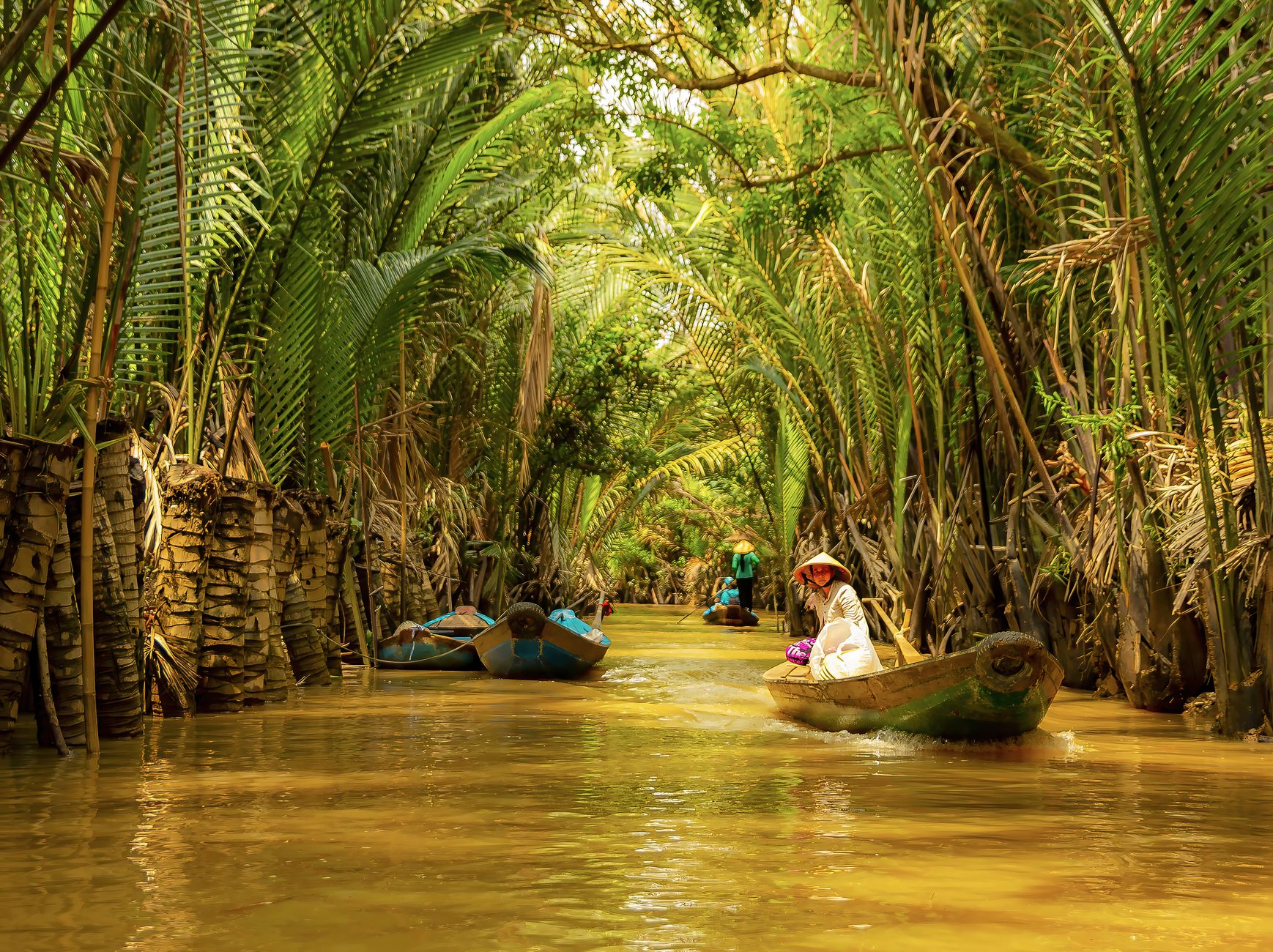
The drive to and from the statue along the coast passes through mangrove country, shrimp farms, and small fishing villages. Stop where the road hugs the water — you'll see the kind of working delta landscape that most tourists only glimpse from boat tours around Can Tho.
Ca Mau Cape
If you're already this far south, Ca Mau Cape (Mui Ca Mau) — the southernmost point of mainland Vietnam — is close by. Combine the two into a single day trip from Ca Mau city.
Where to eat nearby
Dat Mui commune isn't a food destination, so eat in Ca Mau city before or after. Two things to look for:
- "Bun nuoc leo" — a southern delta noodle soup with fermented fish broth, shrimp, roast pork, and fresh herbs. It's a Soc Trang/Ca Mau specialty you won't easily find further north. Street stalls near Ca Mau market serve it for 25,000–35,000 VND.
- Grilled mud crab — Ca Mau province is famous for its mangrove crabs. Seafood restaurants along the Ca Mau city waterfront serve them grilled with salt and chili or steamed with beer. Expect 200,000–400,000 VND per kg depending on size and season.
Where to stay
Stay in Ca Mau city and day-trip to the statue. There's no real accommodation near the site itself.
- Budget: Guesthouses and mini-hotels around the bus station, 200,000–350,000 VND/night. Basic but clean.
- Mid-range: Muong Thanh or Anh Nguyet hotel, 500,000–800,000 VND/night. Air conditioning, hot water, breakfast included.
- Higher-end options are limited — Ca Mau city doesn't have international-brand hotels. The best rooms in town top out around 1,000,000 VND.

Photo by Ákos Helgert on Pexels
Practical tips locals would tell you
- Dress modestly. This is an active religious site. Cover shoulders and knees. You'll see Vietnamese visitors in long sleeves regardless of the heat.
- Bring water and sun protection. There's limited shade on the main approach, and the concrete reflects heat. Midday visits in March–April are brutal.
- Arrive early. The complex opens at dawn. Morning visits (6:00–9:00 AM) are cooler and less crowded.
- Carry cash. There are no ATMs near the site. Stock up in Ca Mau city.
Common mistakes to avoid
- Not budgeting enough time for the drive. The 100 km from Ca Mau city takes over two hours on delta roads, not one. Plan accordingly.
- Expecting English signage or guides. There's essentially none. Download a Vietnamese phrasebook or translation app.
- Skipping the surroundings. People drive to the statue, take a photo, and drive back. The delta landscape along the coast road is half the point of going this far south.
- Visiting during heavy rain. The unpaved areas of the complex flood quickly in wet season downpours. Check weather before committing to the trip.
Practical notes
Phat Ba Nam Hai is free to enter. Donation boxes are available throughout the complex. The site is genuinely remote by Vietnamese tourism standards — that's part of its appeal, but it also means planning ahead on transport and supplies. If you're already exploring the deep Mekong Delta beyond Can Tho, this is a worthwhile stop that most foreign travelers miss entirely.
Last updated · May 29, 2026 · independently researched, never sponsored.