What it is
Nha Tho Da Sapa — the Holy Rosary Church, or simply "the stone church" — sits at the dead center of Sapa town, facing the main square. Built by French missionaries between 1926 and 1935, it's one of the few colonial-era structures in the northwest highlands that survived both wars and decades of neglect mostly intact. The walls are cut from local granite, which is why it earned the name "nha tho da" (stone church). The bell tower rises about 20 meters, and on a clear morning you can see it from halfway across the valley.
The church still functions as a Catholic parish. Mass is held on Sundays, and Hmong and Dao parishioners from surrounding villages often walk in for services. It's not a museum — it's a working building with a congregation.
Why travelers go
Three reasons, honestly:
-
It's the geographic anchor of Sapa (사파 / 沙坝 / サパ) town. The square in front of the church is where the Saturday night market sets up, where tour groups meet, and where most walking routes begin. You'll pass it multiple times whether you plan to or not.
-
The architecture is unusual for the region. A Romanesque stone church at 1,600 meters elevation, surrounded by Hmong market stalls and misty mountains — it's visually striking without trying to be.
-
It's a useful orientation point. The church square connects to Ham Rong Mountain trail (300m uphill), the main market street (Cau May), and the path down toward Cat Cat Village.
Best time to visit
The church is open and visible year-round, but timing matters for photos and atmosphere:
- September to November — clearest skies, golden rice terraces in the valley below, comfortable 15-22°C days.
- December to February — fog rolls in thick most mornings. The church half-disappearing into cloud is atmospheric, but you might not see the bell tower from 50 meters away. Temperatures drop to 3-8°C at night.
- Saturday evening — the "love market" (now mostly a regular night market for tourists) fills the square with food stalls and Hmong textile vendors. The church is lit up and the square gets lively from about 7pm.
- Sunday morning before 9am — if you want to see the church doing what it was built for, show up for mass. Be respectful; sit in the back if you're observing.
How to get there
Sapa is in Lao Cai province, about 350km northwest of Hanoi.
From Hanoi
- Bus: Multiple sleeper buses run overnight from My Dinh bus station (6-7 hours, 250,000-350,000 VND). Some go direct to Sapa town; others drop you in Lao Cai city, where you transfer to a minibus (45 minutes, 50,000 VND).
- Train + bus: Take the overnight train to Lao Cai station (8 hours, 500,000-900,000 VND depending on berth class), then a minibus or taxi up the mountain road to Sapa (35km, about 45 minutes).
Within Sapa
Once in town, the church is impossible to miss. It's at the intersection of Cau May and Thach Son streets, directly on the main square. Everything in central Sapa is walkable — the town core is maybe 800 meters end to end.

Photo by Quang Nguyen Vinh on Pexels
What to do
The church itself takes 10-15 minutes to appreciate from outside. The interior is modest — wooden pews, simple altar, stained glass that's been partially replaced over the decades. If the door is open on a non-service day, you can step in briefly.
The real value is what radiates outward:
- Ham Rong Mountain — the trailhead is a 3-minute walk uphill from the church. Entry is 70,000 VND. Orchid gardens, stone paths, and a viewpoint over the whole valley.
- Sapa Market — the covered market building is 100 meters east of the church. Ground floor has produce, meat, and spices. Upper level has textiles and tourist goods.
- Cat Cat Village — follow the road downhill from the square for about 2km to reach this Hmong village (entry 100,000 VND). Waterfall, rice terraces, and traditional houses.
- Photography — early morning (6-7am) and late afternoon give the best light on the stone facade. The church faces roughly east, so sunrise catches the front wall.
Where to eat nearby
The streets around the church square are packed with restaurants. Some worth knowing:
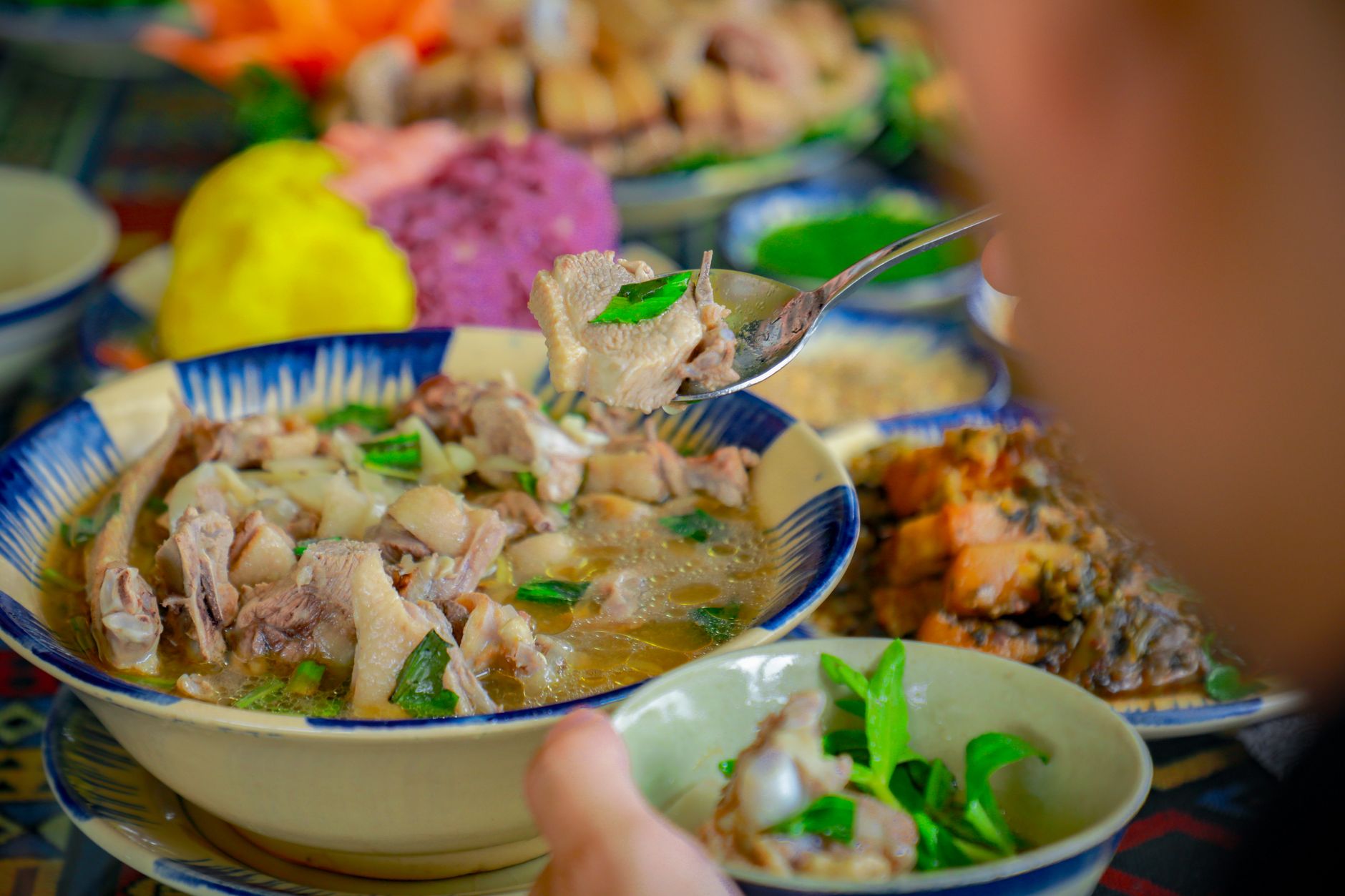
- "Thang co" stalls at the market — "thang co" is a Hmong horse-meat hotpot soup, an acquired taste but culturally significant. Small bowls from 30,000 VND.
- Baguette stalls on Cau May — Sapa's take on banh mi leans heavy on pate and grilled pork. 25,000-35,000 VND.
- Hill Station Signature Restaurant — 200m from the church, in a restored French-era building. Western-Vietnamese fusion. Mains 150,000-300,000 VND. Good Vietnamese coffee here too.
- "Com binh dan" on Thach Son — two or three local rice-and-dish joints serve lunch to construction workers and guides. Point at what looks good. 40,000-60,000 VND for rice with two dishes.
If you're in Sapa for breakfast, [egg coffee](/posts/egg-coffee-hanoi (하노이 / 河内 / ハノイ)-ca-phe-trung) has made it up the mountain — a couple of cafes on Cau May do decent versions.
Where to stay
Accommodation clusters around the church in rings:
- Budget (200,000-500,000 VND/night): Hostels and guesthouses on Muong Hoa and Cau May streets. Basic but walkable to everything.
- Mid-range (800,000-1,500,000 VND/night): Boutique hotels on Thach Son and Dong Loi streets, some with valley-view balconies.
- Upscale (2,000,000+ VND/night): The bigger resorts sit on the edge of town or partway down the valley. You'll need a taxi or shuttle to reach the church.
For proximity, anything within 300m of the square puts you in the middle of things — which also means noise from karaoke bars after 9pm. Light sleepers should book one street back from Cau May.

Photo by Quyển Phạm Xuân on Pexels
Practical tips
- Dress code: The church is conservative — cover shoulders and knees if entering during services. Outside, nobody cares.
- Photography inside: Don't use flash during mass. Outside of services, quick photos are fine.
- Weather prep: Even in summer, Sapa mornings can be cool (14-18°C). Bring a light jacket for early walks to the square.
- ATMs: There are two ATMs within 100m of the church (Agribank and BIDV). Both accept international cards but charge 22,000-55,000 VND per withdrawal.
- Weekend crowds: Saturday afternoon through Sunday morning is peak tourist density around the square. Weekday mornings are quieter.
Common mistakes
- Skipping it because it looks small. The church isn't the destination — it's the starting point. Use it as your base to orient walks, find food, and meet guides.
- Only visiting at midday. The light is flat, the square is crowded, and the fog has usually burned off. Come at dawn or dusk.
- Confusing Sapa town with Sapa district. The church is in town center. The famous rice terraces (Muong Hoa Valley, Ta Phin, Lao Chai) are 7-15km out and require transport or a guided trek.
Practical notes
Nha Tho Da is free to visit from outside and functions as the social center of Sapa town. Budget 30 minutes for the church and square, then branch out. If you're heading to Sapa for trekking, the church is where every route begins — whether you planned it that way or not.
Last updated · May 26, 2026 · independently researched, never sponsored.