What Suoi Mo Ga actually is
Suoi Mo Ga is a natural stream system tucked into a limestone valley in Pho Yen area of Thai Nguyen province, about 75 km north of Hanoi. The name translates roughly to "Chicken Beak Stream" — named after a rock formation near the source that, with some imagination, looks like a rooster's head. The stream runs through a narrow valley shaded by old-growth trees, with shallow pools, small cascades, and rock slabs that locals have been picnicking on for decades.
This isn't a national park or a manicured tourist attraction. It's the kind of place that Thai Nguyen residents drive to on weekends with a cooler of food and a hammock. The surrounding area falls within what was traditionally Thai Nguyen province — following recent administrative reorganization that merged parts of Bac Kan into the greater Thai Nguyen area, the geography hasn't changed, but you may see updated province names on newer maps.
A small temple complex sits near the entrance, dating back several hundred years and tied to local folk legends about a golden rooster that supposedly led villagers to the water source during a drought. It's modest — don't expect Bai Dinh scale — but it adds some context to the walk in.
Why travelers go
Most foreign visitors skip Suoi Mo Ga entirely because it doesn't appear on the usual Hanoi day-trip lists alongside Ninh Binh (닌빈 / 宁平 / ニンビン) or Ha Long Bay. That's fair — it's a smaller-scale destination. But if you're spending time in Thai Nguyen (maybe visiting tea plantations, or passing through on the way north toward Ha Giang or Cao Bang), Suoi Mo Ga is a solid half-day stop.
The draw is simple: cool water, forest shade, and very few tourists who aren't Vietnamese. The stream pools are shallow enough to wade in, the air temperature drops noticeably under the canopy, and the whole valley has a quiet that's hard to find this close to Hanoi (하노이 / 河内 / ハノイ). It's a place to slow down, not to tick off a checklist.
Best time to visit
The sweet spot is April through October, when it's warm enough to actually enjoy getting in the water. Peak local season is June to August — weekends get busy with families from Thai Nguyen city and even Hanoi day-trippers, so aim for a weekday if you can.
Avoid the heavy rain weeks of July and August if there's been flooding upstream — the stream can rise fast and the rocks get slippery. November through March is cooler and quieter, but the water is cold and many of the small food stalls near the entrance shut down.
How to get there from Hanoi
Suoi Mo Ga is roughly 75 km north of central Hanoi, reachable in about 1.5 to 2 hours depending on traffic.
- Motorbike: The most flexible option. Take QL3 (National Road 3) north through Dong Anh and Pho Yen. The road is decent and mostly flat. Fuel cost round-trip runs about 60,000–80,000 VND.
- Bus + xe om: Catch a bus from My Dinh bus station to Thai Nguyen city (around 70,000–90,000 VND, 1.5 hours), then grab a local xe om or taxi for the remaining 15–20 km to the site. A Grab bike from Thai Nguyen city costs roughly 50,000–70,000 VND one way.
- Private car/taxi: A round-trip car hire from Hanoi runs about 1,200,000–1,500,000 VND for the day, which makes sense if you're combining Suoi Mo Ga with tea village visits.
Entrance fee at the site is modest — typically 20,000–30,000 VND per person.

Photo by Hồng Quang Official on Pexels
What to do
Wade and swim in the stream pools
The main activity. The stream has several natural pools ranging from ankle-deep to waist-deep, with smooth rock bottoms. Bring water shoes — the rocks are uneven and algae-coated in spots. The deepest pools are further upstream, about a 20-minute walk from the entrance.
Walk to the upper cascades
A trail follows the stream uphill for about 2 km. It's not strenuous, but it's uneven — flip-flops won't cut it. The further you go, the fewer people you'll encounter. The upper cascades are small (2–3 meters) but the pools beneath them are the clearest.
Visit the temple complex
The temple near the entrance is worth 15 minutes. It's a modest local pagoda with incense and a few altars, not a major heritage site, but it's well-maintained and gives you a sense of the spiritual connection locals have with the stream.
Hammock and picnic
Do what the locals do: rent a hammock spot (10,000–20,000 VND) from one of the families who run informal rest areas along the stream, and just exist for a few hours. Bring your own food or buy from the stalls.
Explore the tea plantations nearby
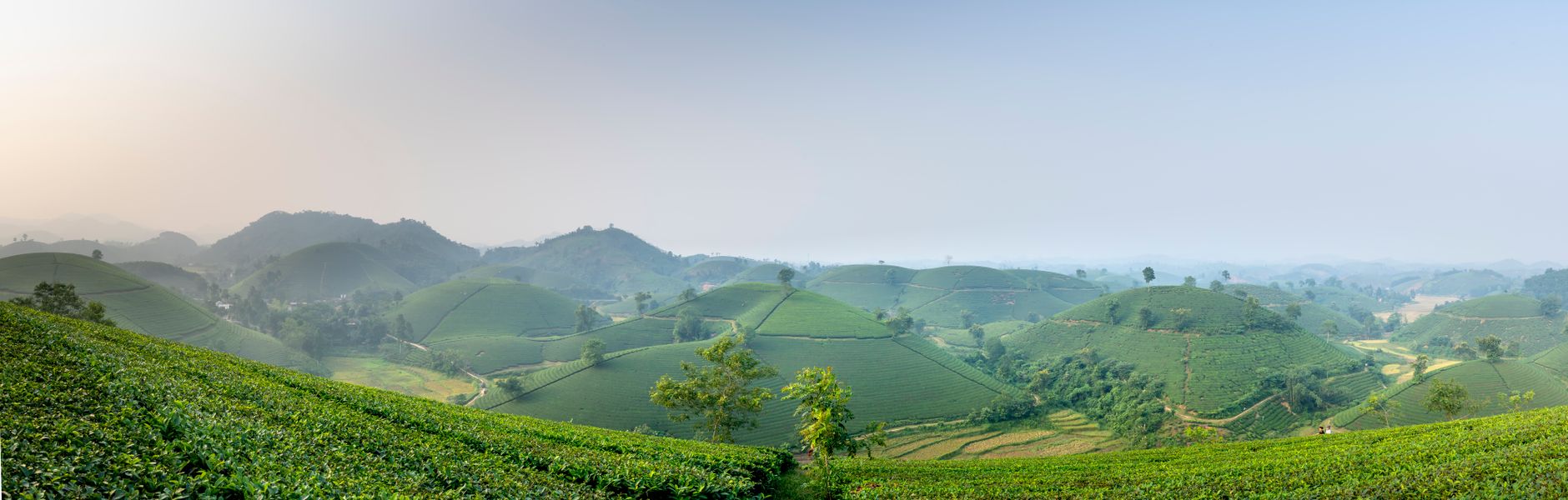
Thai Nguyen is Vietnam's most famous tea-growing region. Tan Cuong village, about 15 km from Suoi Mo Ga, produces some of the country's best green tea. Several family-run operations welcome visitors and will walk you through the picking and roasting process. A bag of quality Tan Cuong green tea runs 150,000–300,000 VND.
Where to eat nearby
Don't expect restaurants — this is food-stall and bring-your-own territory.
The stalls near the entrance sell grilled chicken ("ga nuong"), sticky rice wrapped in banana leaves, and boiled corn. The chicken is usually free-range local birds, smaller and chewier than what you'd get in Hanoi, charcoal-grilled with a chili-salt dip. A half chicken with rice runs about 120,000–150,000 VND.
If you're heading back through Thai Nguyen city, look for "bun cha" shops along Luong Ngoc Quyen street. The Thai Nguyen version uses slightly thicker patties than Hanoi's, grilled over longan wood charcoal. A bowl with a side of "nem chua" (fermented pork roll, a northern specialty) costs around 40,000–50,000 VND.
Where to stay
Most visitors do Suoi Mo Ga as a day trip. If you want to overnight:
- Thai Nguyen city has basic hotels and guesthouses in the 200,000–500,000 VND range. Nothing fancy, but clean and functional.
- Homestays closer to the tea villages run 300,000–600,000 VND per night and often include a tea-tasting session.
- There's no accommodation at Suoi Mo Ga itself.

Photo by Mr Alex Photography on Pexels
Practical tips locals would tell you
- Bring your own water shoes and a dry bag. The stream pools are the whole point, and your phone doesn't need to join you.
- Pack food if visiting on a weekday. The stalls sometimes don't open unless there's weekend traffic.
- Carry cash. There's no ATM at the site and none of the stalls take cards.
- Sunscreen matters even under tree cover. The open stretches between pools will burn you faster than you think.
- Bring a trash bag. Litter is an ongoing problem at the site, and you'll feel better leaving it cleaner than you found it.
Common mistakes to avoid
- Going on a summer weekend without a plan. The parking area fills up, the pools get crowded, and the hammock spots are claimed by 9 AM. Arrive early or go midweek.
- Wearing flip-flops on the upstream trail. You'll slip. Guaranteed.
- Expecting a big waterfall. Suoi Mo Ga is a stream with cascades, not Ban Gioc. Calibrate your expectations and you'll enjoy it more.
- Skipping the tea villages. Suoi Mo Ga alone is a half-day outing. Combining it with a tea plantation visit in Tan Cuong makes the trip from Hanoi feel worthwhile.
Practical notes
Suoi Mo Ga works best as part of a broader Thai Nguyen day trip — stream in the morning, tea villages in the afternoon, bun cha in the city before driving back to Hanoi. It's not a destination that justifies a multi-day detour, but it's a genuinely pleasant few hours in a part of the north that most travelers drive straight through.
Last updated · May 29, 2026 · independently researched, never sponsored.