
What it is
Thap Co Binh Thanh is an 11th-century Cham brick tower sitting on a low hill in Tay Ninh province, about 100 km northwest of Saigon. It's one of the southernmost Cham towers still standing in Vietnam (베트남 / 越南 / ベトナム), and unlike the more visited ruins at Po Nagar or My Son, you'll likely have the place almost entirely to yourself.
The tower was built during the late period of the Champa kingdom, probably sometime between the 10th and 12th centuries, and served as a Hindu temple — most likely dedicated to Shiva. It's a single main tower, roughly 10 meters tall, constructed from fired brick without mortar in the classic Cham technique where bricks were ground and fitted so tightly they've held together for a millennium. The site was classified as a national historical relic in 1993.
What makes it worth the detour isn't scale — it's modesty. This is a single tower on a grassy mound surrounded by rice paddies and longan orchards, with zero tourist infrastructure. It feels like stumbling onto something the guidebooks forgot.
Why travelers go
Most visitors to Tay Ninh head straight for the Cao Dai Holy See temple, and honestly, that's the bigger draw. But if you're already in the province, Thap Co Binh Thanh adds a completely different texture to the day. The Cao Dai temple is ornate, busy, and theatrical. The Cham tower is quiet, weathered, and rural. Together they make a surprisingly rich day trip from Saigon (사이공 / 西贡 / サイゴン).
Photographers come for the late afternoon light on the brickwork. History-minded travelers come because Cham heritage in the deep south is rare — most Cham sites cluster around Nha Trang, Quy Nhon, and Da Nang. And some people come simply because they like places where nobody else goes.
Best time to visit
Tay Ninh has two seasons: wet (May to November) and dry (December to April). The dry months are more comfortable — less mud on the path up the hill, clearer skies for photos. December through February is the sweet spot: cooler temperatures (by southern Vietnam standards, meaning low 30s instead of high 30s) and almost no rain.
Avoid visiting during the midday heat regardless of season. The site has no shade structures. Early morning or late afternoon — say before 9 AM or after 3:30 PM — is when the light is best and the heat is manageable.

Photo by Haneul Trac on Pexels
How to get there from Saigon
Thap Co Binh Thanh sits in Tan Bien district, roughly 100 km from central Saigon. You have a few options:
By motorbike: The most flexible way. Take Highway 22 Highway) northwest through Cu Chi toward Tay Ninh city, then continue north on provincial roads toward Tan Bien. Total ride is about 2.5 to 3 hours depending on traffic out of Saigon. Fuel cost around 80,000-100,000 VND round trip.
By bus + xe om: Catch a bus from An Suong bus station (western Saigon) to Tay Ninh city — around 70,000-90,000 VND, roughly 2.5 hours. From Tay Ninh city, you'll need a local "xe om" (motorbike taxi) or grab a Grab bike for the remaining 30-odd km north to the tower. Expect to pay 100,000-150,000 VND for the xe om leg.
By car (private or hired): A hired car with driver from Saigon runs 1,200,000-1,500,000 VND for the full day, which is the easiest option if you want to combine the Cham tower with the Cao Dai temple and Ba Den Mountain in a single trip.
What to do
Walk the tower up close
The main tower is compact enough to circle in a few minutes, but take your time. Look at the brickwork joints — there's no visible mortar, and after a thousand years, the seams are still tight in most places. The decorative carvings around the doorframe, though eroded, show linga and floral motifs typical of late-period Cham art. The entrance faces east, standard for Cham Hindu temples.
Explore the surrounding mound
The tower sits on a raised earthen platform that was likely part of a larger temple complex. Walk the perimeter of the hill. Archaeological digs here have turned up sandstone linga, ceramic fragments, and structural foundations suggesting at least two or three other buildings once stood nearby. You won't see excavation trenches now — the area is grassed over — but it gives a sense of how much more existed here.
Photograph the rice paddy backdrop
The tower's setting is its secret weapon. From the base of the hill, you get the ancient brick silhouette against flat green paddies stretching to the horizon. During harvest season (around March-April and August-September), the fields turn gold. Bring a wide-angle lens.
Visit the small on-site display
There's a modest display area near the entrance with a few information panels (mostly in Vietnamese) and some recovered artifacts. Don't expect a museum — it's more like a single room — but it gives useful context about the Champa presence in this region.
Combine with the Cao Dai Holy See
The Cao Dai Great Temple in Tay Ninh city is about 30 km south. The noon prayer ceremony (around 12:00 PM) is open to respectful visitors and is genuinely unlike anything else in Vietnam — a syncretic religion with an aesthetic somewhere between a Catholic cathedral and a Vietnamese dragon palace. Pairing it with Thap Co Binh Thanh makes a full and varied day.
Where to eat nearby
Tan Bien district isn't a food destination, so plan accordingly. In Tay Ninh city, seek out "banh canh" Tay Ninh style — thick tapioca noodles in a pork-bone broth with sliced pork and fried shallots. It's the province's signature dish, and small shops along Cach Mang Thang Tam street serve solid bowls for 30,000-40,000 VND.
Also worth trying: "banh trang phoi suong" — Tay Ninh's famous rice paper, slightly chewy from overnight dew-drying, eaten with dipping sauces or grilled. Street vendors sell portions for 15,000-20,000 VND. It's a regional snack you won't easily find elsewhere.
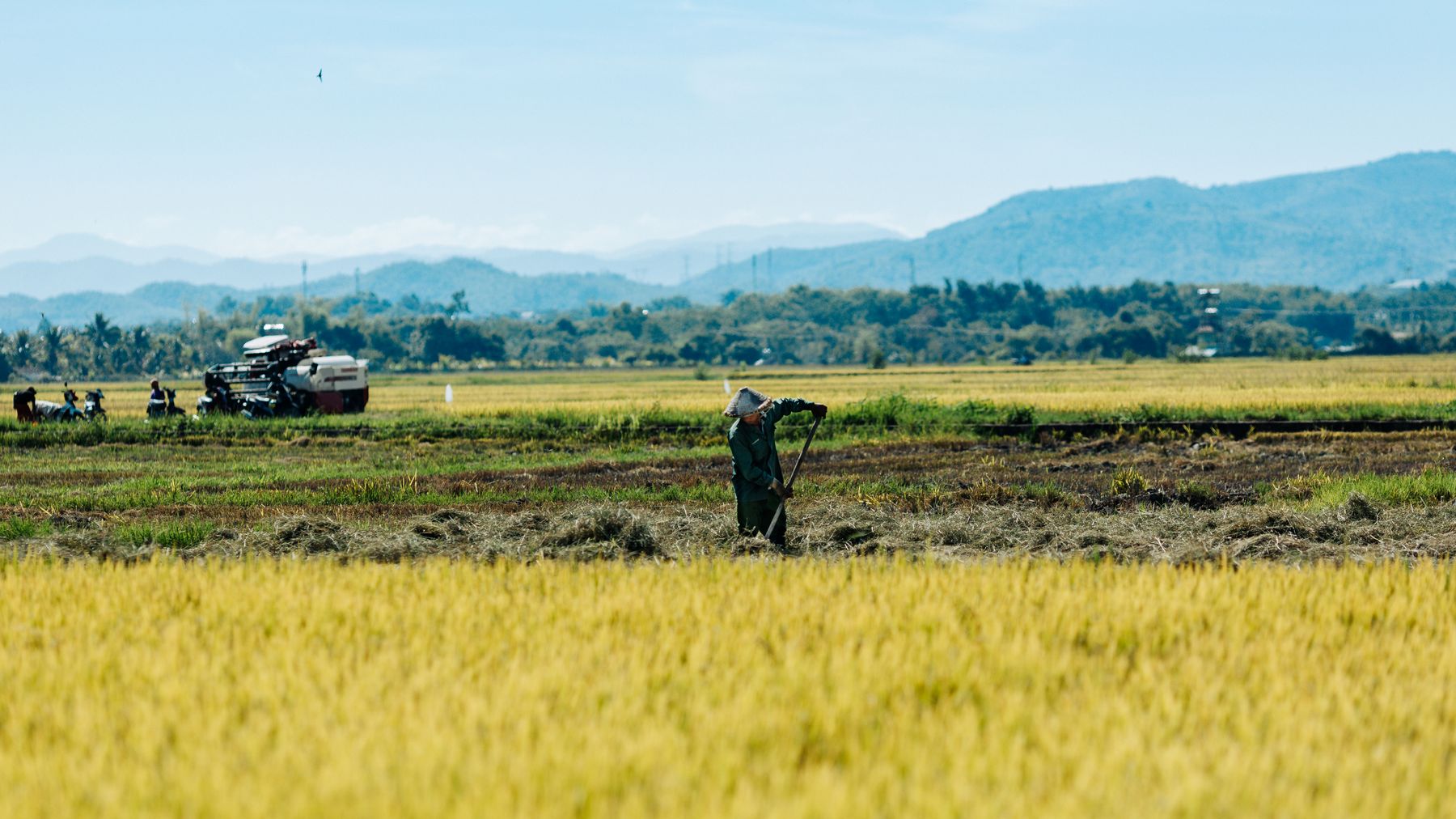
Photo by Thái Trường Giang on Pexels
Where to stay
Most travelers visit Thap Co Binh Thanh as a day trip from Saigon. If you want to overnight in Tay Ninh, options are basic but functional:
- Budget guesthouses (nha nghi): 200,000-350,000 VND per night around Tay Ninh city center. Clean enough, fan or basic AC, don't expect English.
- Mid-range hotels: 400,000-700,000 VND. A few newer places along the main road have proper AC, hot water, and Wi-Fi. Vinpearl Hotel Tay Ninh is the most modern option if you want reliability.
Practical tips locals would tell you
- Bring water and sun protection. There's no shop at the tower site.
- Wear shoes with grip — the path up the hill is dirt and can be slippery after rain.
- The site is free to enter. No ticket booth, no gates.
- Phone signal is fine (Viettel works best in rural Tay Ninh). Don't count on finding an ATM near the tower — withdraw cash in Tay Ninh city.
- If you're on a motorbike, fill up in Tay Ninh city. Gas stations thin out heading north toward Tan Bien.
Common mistakes to avoid
- Going without combining other stops. The tower alone justifies maybe 30-45 minutes. Without pairing it with the Cao Dai temple or Ba Den Mountain, the 3-hour ride from Saigon feels disproportionate.
- Showing up at midday. Full sun, no shade, brutal heat from March to May. Time your visit for early morning or late afternoon.
- Expecting signage in English. There's almost none. Read up before you go or you'll stand in front of a beautiful old tower with no context.
- Skipping it because it's "just one tower." That's actually the appeal. Not everything needs to be a sprawling complex to be worth seeing.
Last updated · May 29, 2026 · independently researched, never sponsored.








