What it is
Lai Vung district, in Dong Thap province, has been growing "quyt hong" — a variety of tangerine with a distinctive pinkish-orange skin and honeyed sweetness — for over a century. The orchards stretch along the banks of canals feeding off the Mekong, and during harvest season the trees hang so heavy with fruit that farmers prop up branches with bamboo poles to keep them from snapping. It's not a theme park or a ticketed attraction. It's a working agricultural district where families have tended the same plots for generations, and travelers are welcome to walk in, pick fruit, and eat as much as they can handle.
The fruit itself is what draws people. "Quyt hong" Lai Vung has a reputation across southern Vietnam (베트남 / 越南 / ベトナム) the way Ninh Thuan grapes or Binh Thuan dragon fruit do — it's a regional product people associate with quality and place. The skin peels easily, the segments are almost seedless, and the flavor sits somewhere between a mandarin and a clementine, with a floral note you won't find in supermarket citrus.
Why travelers go
Most visitors to the Mekong Delta (메콩 델타 / 湄公河三角洲 / メコンデルタ) head straight to Can Tho for the floating markets and call it done. Lai Vung offers something different: a quieter, more agricultural slice of delta life without the tourist infrastructure — or the tourist prices. You're not watching a performance of rural Vietnam. You're walking through someone's orchard, buying fruit by the kilogram, and drinking tea in their front yard.
It also pairs well with other Dong Thap attractions. The lotus fields around Thap Muoi, the Xeo Quyt mangrove forest (a former resistance base turned nature reserve), and the Sa Dec flower villages are all within a short drive. A Dong Thap loop makes for one of the better two- or three-day Mekong itineraries that most travelers overlook.
Best time to visit
Harvest season runs roughly from November through late January, peaking around Tet. This is when the orchards are loaded with ripe fruit and open for visitors. Outside this window, the trees are green and there's not much to see — you'd be visiting an orchard with no fruit, which is a bit like visiting a beach town in a rainstorm.
The weeks just before Tet / 越南春节 / テト) (usually late January or early February) are the most photogenic and the most crowded. Farmers sell enormous quantities of tangerines for Tet altar displays — the fruit symbolizes prosperity — so the orchards are buzzing with buyers and wholesalers. If you want a calmer visit, aim for late November or early December. The fruit is ripe, the crowds are thin, and the light in the delta is good.
How to get there
From Saigon, Lai Vung is about 160 km southwest — roughly 3.5 to 4 hours by car or motorbike depending on traffic through Long An province. The most direct route follows QL1A south to My Thuan Bridge, then cuts west into Dong Thap.
From Can Tho, it's closer: about 70 km northeast, or roughly 1.5 hours by car.
Bus: Buses from Saigon's Mien Tay station run to Sa Dec (around 120,000–150,000 VND, 3.5 hours). From Sa Dec, grab a local xe om or rent a motorbike to Lai Vung town — it's about 15 km. There's no direct bus to the orchards themselves.
Motorbike: This is the best way to explore. The orchard roads are narrow canal-side paths, and having your own bike lets you stop at any garden that catches your eye. Rentals in Sa Dec or Can Tho run 120,000–180,000 VND per day.
Organized tour: A few operators in Can Tho and Saigon run Dong Thap day trips that include Lai Vung, usually combined with Sa Dec flower village and Xeo Quyt. Expect 800,000–1,200,000 VND per person.

Photo by Nhẫn Nguyễn on Pexels
What to do
Walk the orchards and pick fruit
Most orchard families charge a modest entry fee — typically 20,000–50,000 VND per person — and let you wander freely, pick tangerines off the trees, and eat on the spot. Additional fruit to take home costs around 30,000–60,000 VND per kilogram depending on the season and quality. The best orchards are along the roads branching off from Lai Vung town center toward the canal banks. Look for hand-painted signs reading "Vuon quyt" or just follow the orange.
Cruise the canals
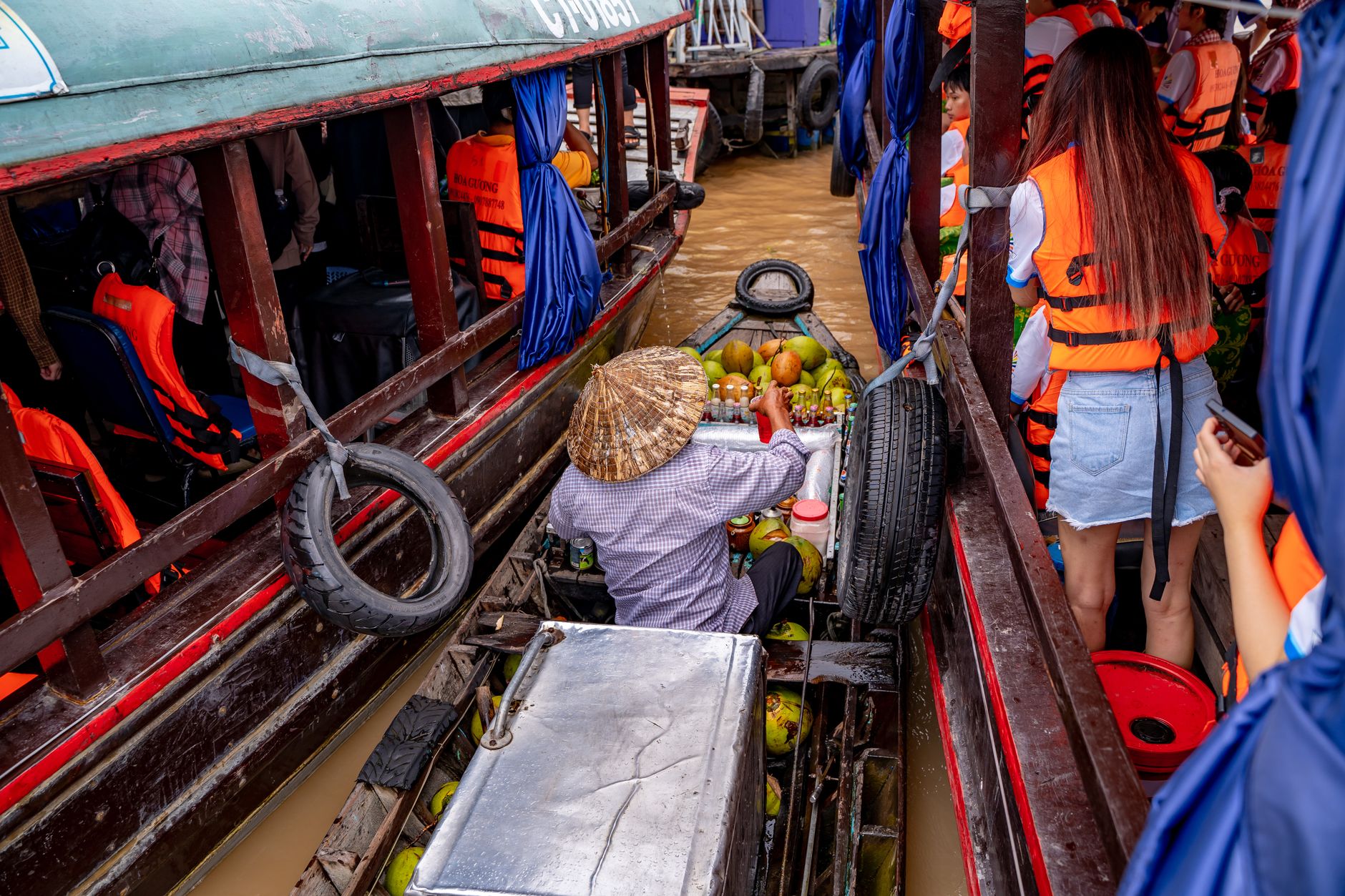
Hire a small sampan (around 100,000–200,000 VND for 30–45 minutes) to float through the canal network between orchards. The waterways are narrow and shaded by fruit trees on both banks. It's one of the more peaceful boat rides in the delta — no engine noise, no loudspeaker commentary.
Visit Xeo Quyt historical site
About 20 km from Lai Vung, this cajuput mangrove forest served as a base during the wars and has been preserved as a nature area. Wooden walkways thread through the flooded forest. Entry is around 30,000 VND. Worth an hour if you're already in the district.
Browse Sa Dec flower village
Sa Dec, 15 km from Lai Vung, is the flower capital of the delta. Hundreds of nurseries grow ornamental plants year-round, but the weeks before Tet are spectacular. Combine it with the Huynh Thuy Le ancient house — the real-life setting behind Marguerite Duras's novel The Lover.
Try the local rice wine
Lai Vung also produces "ruou quyt" — tangerine-infused rice wine. Families sell it in recycled water bottles for 40,000–80,000 VND per liter. It's sweet, low-proof, and dangerously drinkable.
Where to eat nearby
Dong Thap's signature dishes lean toward freshwater fish and lotus. Look for "lau ca linh bong dien dien" — a hotpot made with linh fish and yellow dien dien flowers, available at roadside restaurants around Lai Vung and Sa Dec from roughly September through November. It's a seasonal dish tied to the flooding cycle and one of the more distinctive things you'll eat in the delta.
For something quicker, the area does solid "hu tieu" — the southern-style noodle soup that's lighter and sweeter than its northern equivalents. A bowl runs 25,000–40,000 VND at any market stall in Lai Vung town.
Where to stay
Lai Vung itself has limited accommodation — mostly local guesthouses (nha nghi) in the 150,000–300,000 VND range. They're basic but clean enough for a night.
For more comfort, base yourself in Sa Dec (15 minutes away), which has a handful of mid-range hotels and homestays in the 400,000–800,000 VND bracket. Can Tho is the nearest city with proper hotel infrastructure, including international chains, if you prefer that.
Homestays in the orchard areas occasionally pop up during harvest season — ask around in Lai Vung town or check local Facebook groups. Sleeping in an orchard with fruit hanging overhead is a genuinely good experience.

Photo by Flint Huynh on Pexels
Practical tips locals would tell you
- Wear a hat and sunscreen. The orchards have shade, but the roads between them don't. Delta sun in December is still strong.
- Bring cash. There are no ATMs in the orchards and few in Lai Vung town itself. Load up in Sa Dec or Can Tho.
- Go early. Orchard families are up at dawn. Visiting by 7–8 AM means cooler temperatures and better light for photos. By noon, the heat makes everything sluggish.
- Don't haggle aggressively on fruit prices. These are small family operations, not tourist traps. The prices are already reasonable.
Common mistakes to avoid
- Visiting outside harvest season. If you show up in July, you'll see green trees and closed gates. Check dates before you commit.
- Trying to do it as a Saigon day trip. The 3.5-hour drive each way makes for an exhausting round trip. Stay overnight in the area — combine it with Sa Dec and Can Tho for a proper two- or three-day Mekong loop.
- Skipping the canals. Walking the orchards is good, but seeing them from the water adds a different perspective. Budget 30 minutes for a sampan ride.
Practical notes
Lai Vung is one of those places that rewards travelers who don't need a checklist. The appeal is slow, seasonal, and agricultural — you eat tangerines, float on canals, and watch the delta do its thing. Plan around the November–January harvest window, give yourself at least one overnight in the area, and bring an appetite for fruit.
Last updated · May 29, 2026 · independently researched, never sponsored.