What it is
Cai Be sits along the Tien River in Dong Thap province, about 110 km southwest of Saigon. The fruit orchards here — called "vuon trai cay" — aren't a single attraction with a ticket booth. They're a network of family-run gardens spread across river islands and canal-laced land, where longan, rambutan, mangosteen, jackfruit, durian, and pomelo grow in dense, shaded rows. Families have farmed these plots for generations, and many now open their gates to visitors for a modest fee.
The area is best known for the Cai Be floating market, which once rivaled Can Tho's Cai Rang market in size. That market has shrunk considerably over the past decade as roads improved and wholesale trade moved to land. But the orchards remain, and honestly, they're the better reason to come.
Why travelers go
People visit Cai Be's orchards because the Mekong Delta (메콩 델타 / 湄公河三角洲 / メコンデルタ) is at its most tangible here — not packaged, not narrated through a megaphone on a tour bus. You sit in a narrow sampan, glide under canopies of water coconut palms, step onto someone's garden plot, and eat fruit that was on a branch thirty seconds ago. There's no entrance complex, no souvenir gauntlet.
It's also significantly less crowded than the orchards near My Tho or Ben Tre, which absorb most of the day-trip traffic from Saigon (사이공 / 西贡 / サイゴン). Cai Be gets fewer visitors, which means the families running the orchards are more relaxed, more willing to sit and talk over tea.
Best time to visit
Fruit season peaks from May through July, when rambutan, mangosteen, and durian are all in harvest at once. This is also early rainy season, so expect afternoon downpours — they're short, heavy, and actually cool things down.
January through March is drier and more comfortable temperature-wise (28-32°C), but the fruit variety drops. You'll still find pomelo, star fruit, and longan year-round. If durian matters to you, aim for June.
Avoid the weeks right around Tet (late January or early February) unless you want to see the flower barges — orchards may close as families celebrate.

Photo by Vietnam Tri Duong Photographer on Pexels
How to get there
From Saigon, the most practical route is a bus from Mien Tay bus station to Cai Be town. Phuong Trang (FUTA) and Hung Cuong both run this route. The trip takes about 2.5 hours and costs 90,000-120,000 VND. Buses drop you at Cai Be bus station on National Highway 1A, from where you take a xe om (motorbike taxi) about 3 km to the river pier — around 20,000-30,000 VND.
If you're coming from Can Tho, it's roughly 100 km northeast, about 2 hours by bus or car.
Renting a motorbike from Saigon is doable if you're comfortable with highway traffic. The ride down QL1A is flat and straightforward, though the last stretch through town requires navigating narrow lanes toward the water.
Once at the pier, you'll hire a boat. A private sampan for 2-4 people costs 250,000-400,000 VND for a 2-3 hour loop through the orchards and canals. Larger motorized boats for groups run 600,000-800,000 VND. Negotiate before boarding and confirm what's included — most boat trips stop at 2-3 orchards and a coconut candy workshop.
What to do
Walk the orchard rows
Most orchards charge 30,000-50,000 VND entry, which includes all the fruit you can eat on-site. The etiquette is simple: the family picks for you or shows you what's ripe, you eat, you don't stuff a bag to take home (though you can buy extra to carry). Durian, mangosteen, and rambutan straight off the tree taste nothing like what you get at a Saigon market stall three days later.
Ride a sampan through the canals
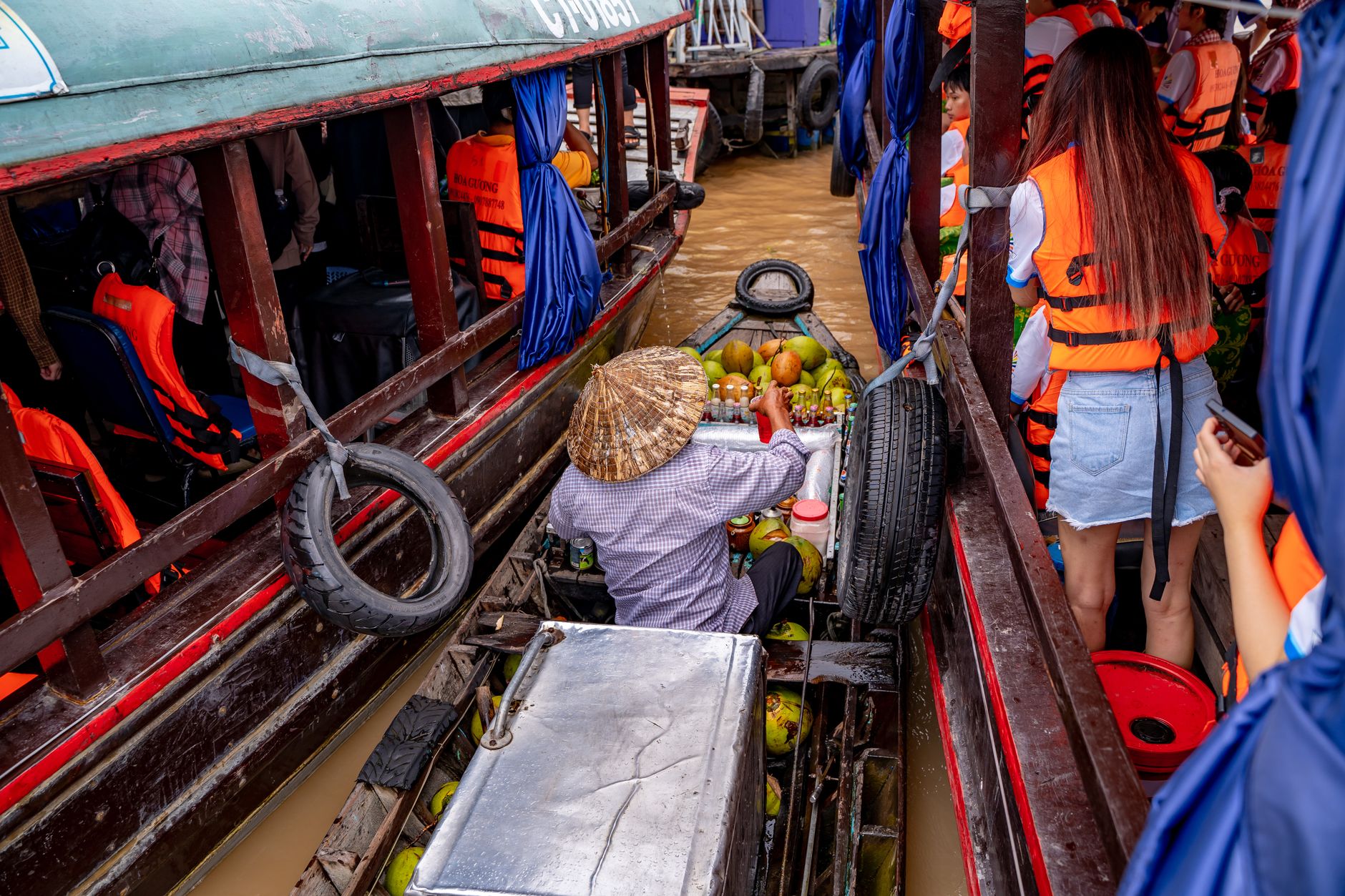
The narrow canals behind the main river are the real draw. Water coconut palms form a green tunnel overhead. It's quiet except for the paddle and the occasional chicken. Your boatwoman — it's almost always a woman — will point out fruit trees, fish traps, and the odd monitor lizard. This isn't performative. People actually live and farm here.
Visit the floating market at dawn
Cai Be floating market starts around 5:00-5:30 AM and winds down by 8:00 AM. It's smaller than it used to be — maybe 20-30 boats on a busy morning — but that's part of why it feels real. Wholesalers hang samples of their goods from tall poles on the boat mast: a pineapple means they sell pineapples, a squash means squash. Buy a bowl of "hu tieu" from one of the floating kitchen boats for about 25,000 VND.
Watch coconut candy being made
Several families along the canal route produce coconut candy by hand — boiling coconut milk with sugar and malt, pulling the toffee, cutting and wrapping it. It's a quick stop, maybe 15 minutes, and they'll offer samples. A bag costs 20,000-40,000 VND. Not life-changing, but it's a genuine cottage industry, not a factory dressed up for tourists.
Cycle the island paths
Some guesthouses and homestays rent bicycles for 50,000-70,000 VND per day. The paths on Tan Phong island are flat, shaded, and almost car-free. You'll pass fruit orchards, rice paddies, small temples, and kids who wave.
Where to eat nearby
The Mekong Delta runs on river fish. Look for "ca tai tuong chien xu" — elephant ear fish, deep-fried whole until the skin is crackling, then wrapped in rice paper with herbs and dipped in tamarind sauce. It's the signature dish of the region and almost every riverside restaurant in Cai Be serves it for 150,000-200,000 VND.
For something quicker, grab a plate of "com tam" with grilled pork from the market stalls near the bus station — 35,000-45,000 VND. If you're on the water in the early morning, hu tieu from a floating kitchen boat is breakfast sorted.

Photo by Vika Glitter on Pexels
Where to stay
Cai Be has a handful of homestays on the river islands, mostly in the 300,000-500,000 VND per night range. These are simple — a fan room, mosquito net, shared bathroom — but the setting is hard to beat. Families cook dinner with whatever they pulled from the garden that day.
For more comfort, Mekong Lodge and a few mid-range resorts sit along the river closer to town, running 800,000-1,500,000 VND per night with air conditioning, pool, and organized tours.
Most Saigon day-trip operators push you through in 6 hours and head back. Staying overnight is worth it — the delta at dusk and dawn is a completely different place.
Practical tips
- Bring cash. There are no ATMs on the islands and most orchard families don't take cards.
- Wear shoes you don't mind getting muddy. Flip-flops work on boats but orchard paths get slippery after rain.
- Mosquito repellent, especially at dusk. The canals are beautiful and buggy.
- If you book a group tour from Saigon, confirm it goes to Cai Be specifically — many "Mekong Delta" tours actually visit My Tho or Ben Tre and call it a day.
Common mistakes
Showing up at the floating market after 7:30 AM and wondering where everyone is. It's a working market, not a show — traders finish early.
Trying to do Cai Be as a half-day trip from Saigon. By the time you arrive, eat lunch, take a boat, and turn around, you've spent more time on the highway than on the water. One night minimum makes the trip worthwhile.
Skipping the orchards and only doing the floating market. The market is interesting, but the orchards and canal rides are what make Cai Be distinct from every other Mekong Delta stop.
Last updated · May 29, 2026 · independently researched, never sponsored.