
What Dam Cu Mong actually is
Dam Cu Mong is a shallow saltwater lagoon stretching roughly 30 square kilometers along Vietnam (베트남 / 越南 / ベトナム)'s central coast, wedged between the provinces of Phu Yen and Binh Dinh. A narrow sand barrier separates it from the East Sea, and the Cu Mong Pass — one of central Vietnam's old mountain road crossings — winds above its northern shore.
The lagoon has been a working fishing ground for centuries. Villages along its edges raise shrimp, harvest clams, and run small-scale aquaculture ponds. Unlike the more famous lagoons further north near Hue, Dam Cu Mong has stayed almost entirely off the tourist circuit. There are no resorts on its banks, no ticket booths, and no Instagram crowds. That's the draw.
Why travelers go
Honestly, most don't — and that's the point. Dam Cu Mong appeals to a specific kind of traveler: someone already moving along the central coast between Quy Nhon and Tuy Hoa who wants to slow down for a day or two.
The lagoon is genuinely photogenic in the early morning, when fishing boats head out and the water goes flat. The surrounding landscape is a mix of green hills, salt flats, and small hamlets connected by narrow concrete paths. It feels like coastal Vietnam did twenty years ago, before the resort boom reshaped places like Da Nang and Nha Trang (냐짱 / 芽庄 / ニャチャン).
If you're interested in seafood at source — watching it come off the boats, buying it wet, eating it grilled at a roadside stall for 40,000-70,000 VND a plate — this is that kind of place.
Best time to visit
March through August gives you the driest, calmest weather. The lagoon is most scenic in the early morning light, roughly 5:30-7:00 AM, when fishermen are active and the haze hasn't burned off yet.
Avoid October through December if you can. Central Vietnam's rainy season hits hard here, and the low-lying roads around the lagoon can flood. January and February are cooler and sometimes overcast, but still workable.
How to get there
Dam Cu Mong sits along the QL1A highway corridor, roughly 30 km north of Tuy Hoa (Phu Yen's provincial capital) and about 50 km south of Quy Nhon.
From Quy Nhon: Ride south on QL1A. You'll cross the Cu Mong Pass and descend directly to the lagoon's northern edge. About 1 hour by motorbike, 45 minutes by car.
From Tuy Hoa: Head north on QL1A toward Binh Dinh. The lagoon appears on your left after roughly 25-30 minutes.
From further afield: The nearest airports are Phu Cat (Quy Nhon, code UIH) and Dong Tac (Tuy Hoa, code TBB). Both have daily flights from Hanoi and Saigon. From either airport, you'll need a taxi or Grab — budget around 200,000-350,000 VND depending on direction.
There's no direct bus service to the lagoon itself. Long-distance buses on the Quy Nhon–Tuy Hoa route pass along QL1A and can drop you at the turnoff near Xuan Thanh or Song Cau town, but you'll need your own wheels from there.
Renting a motorbike
The best way to explore the lagoon perimeter. Rentals in Quy Nhon or Tuy Hoa run 120,000-180,000 VND per day for a semi-automatic Honda Wave or Yamaha Sirius. The roads around the lagoon are mostly paved but narrow — fine for confident riders, stressful for beginners.
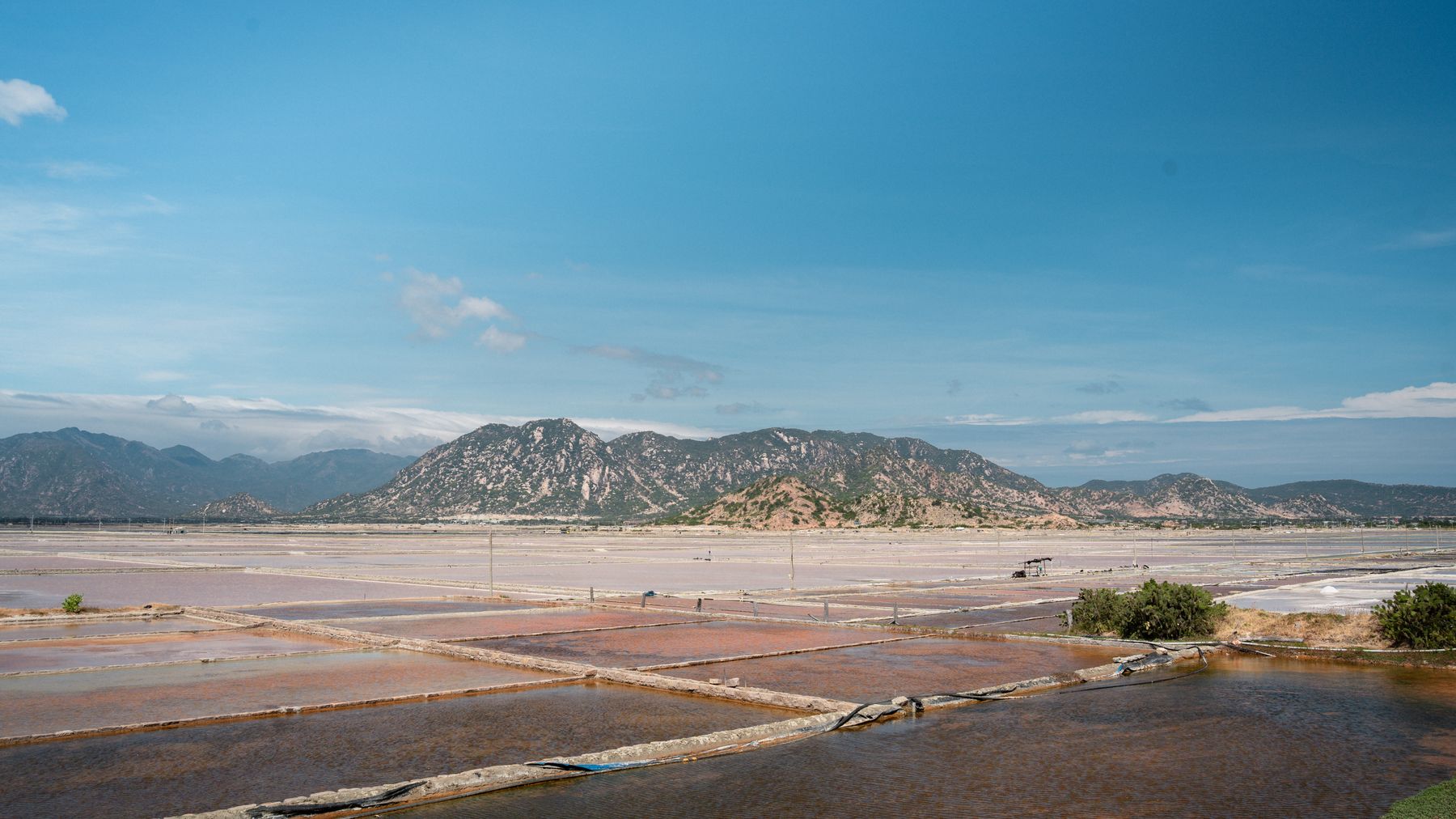
Photo by SICULA Đỗ on Pexels
What to do
Ride the lagoon loop. A rough circuit around Dam Cu Mong covers about 25-30 km on mixed roads. You'll pass through fishing hamlets, shrimp farms, and stretches of empty shoreline. Plan 2-3 hours with stops.
Watch the morning catch. The small docks near Song Cau town (on the lagoon's western shore) are busiest between 5:30 and 7:00 AM. Fishermen offload baskets of clams, small crabs, and shrimp. Nobody minds if you watch and photograph — just stay out of the way.
Cross the Cu Mong Pass. The old pass road (now largely bypassed by a tunnel on QL1A) offers decent views of the lagoon from above. It's a short ride — maybe 6-7 km — and quiet enough that you can stop anywhere on the shoulder.
Visit the salt fields. Small-scale salt production still happens along the lagoon's edges, mostly visible in the dry season. The geometric patterns of the evaporation ponds photograph well from drone altitude, but they're interesting at ground level too.
Where to eat
Song Cau town is your best bet for food. Several small seafood restaurants line the main road, serving whatever came out of the lagoon that morning.
Look for "oc" (snail) dishes and grilled clams with peanut and scallion oil — a central coast staple. A full seafood spread for two people typically runs 150,000-250,000 VND at these spots. "Banh xeo" with shrimp is common here too, and the central coast version tends to be smaller and crispier than what you'd find in Saigon.
For coffee, there's nothing fancy — just standard Vietnamese coffee at roadside "ca phe" stalls. A "ca phe sua da" runs 15,000-20,000 VND.
Where to stay
Dam Cu Mong itself has almost no tourist accommodation. Your realistic options:
Song Cau town: A handful of "nha nghi" (guesthouses) in the 200,000-350,000 VND range. Basic rooms, functional air conditioning, hot water most of the time. Don't expect English-speaking staff.
Quy Nhon (50 km north): The better base if you want comfort. Quy Nhon has a proper range of hotels and hostels from 250,000 VND dorms to 1,500,000 VND boutique rooms. Make Dam Cu Mong a day trip.
Tuy Hoa (30 km south): Fewer options than Quy Nhon but closer. Mid-range hotels along the beach road start around 400,000-600,000 VND.
Photo by SICULA Đỗ on Pexels
Practical tips
- Bring cash. There are no ATMs at the lagoon itself. Song Cau has a couple of bank branches but don't count on them. Withdraw in Quy Nhon or Tuy Hoa before heading out.
- Sunscreen and a hat. There's almost no shade along the lagoon's edges. The central coast sun between 10 AM and 3 PM is serious.
- Fuel up first. Gas stations are spaced out along QL1A but rare on the smaller lagoon roads. Fill your tank before leaving the highway.
- Language barrier. Very few people around Dam Cu Mong speak English. Google Translate's camera mode works passably for menus. Learn "bao nhieu" (how much?) — it covers most transactions.
Common mistakes
Treating it as a full destination. Dam Cu Mong is a half-day to one-day stop, not a multi-day base. Pair it with Quy Nhon's beaches or a run down to Tuy Hoa and the Ganh Da Dia rock formations.
Arriving midday. The lagoon looks flat and washed-out under overhead sun. Morning and late afternoon are when it comes alive — better light, more activity on the water, cooler temperatures.
Skipping the pass. The Cu Mong Pass road takes 20 minutes and gives you the best overview of the lagoon. It's easy to miss if you take the tunnel on QL1A instead.
Final note
Dam Cu Mong won't make anyone's top-ten Vietnam list, and that's exactly why it works. It's a real place doing real things — fishing, farming, getting on with it — and if you're passing through the central coast between Quy Nhon and Tuy Hoa, an early-morning detour here is worth the alarm clock.
Last updated · May 29, 2026 · independently researched, never sponsored.







