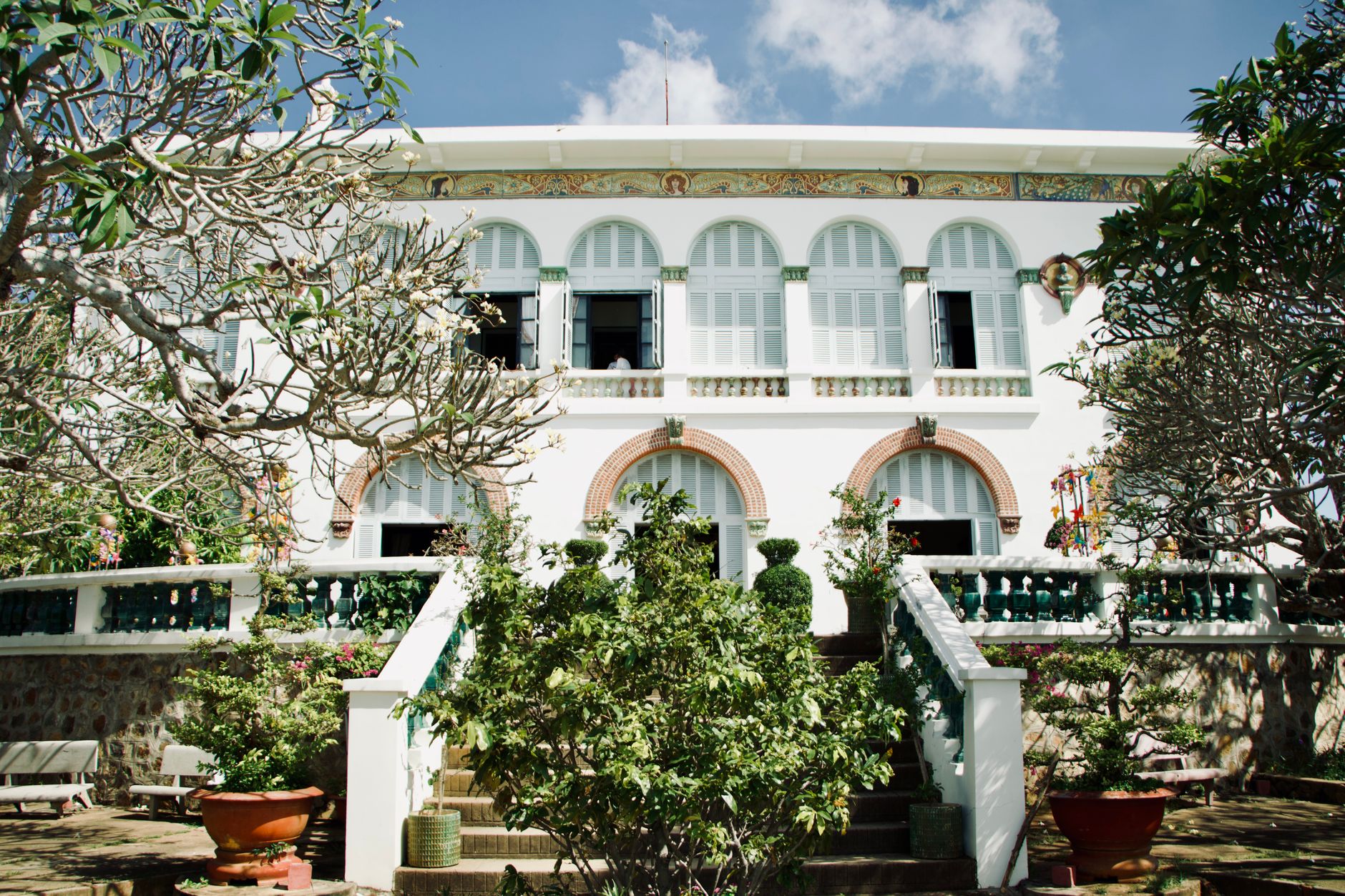
What Cung An Dinh actually is
Cung An Dinh sits on the south bank of the An Cuu canal, about 1.5 km southeast of the Imperial Citadel in Hue. It was built between 1917 and 1919 by Emperor Khai Dinh as his private residence before he took the throne — and later became home to Bao Dai, Vietnam (베트남 / 越南 / ベトナム)'s last emperor, during his youth.
What makes it unusual among Hue (후에 / 顺化 / フエ)'s royal sites is the architecture. This isn't another wooden pavilion with dragon motifs. Cung An Dinh is a three-story European-style villa with reinforced concrete walls, wrought-iron balconies, Art Nouveau flourishes, and interior murals that blend French decorative style with Vietnamese royal symbolism. Think Indochine-era fusion before that became a restaurant concept.
Khai Dinh had a well-documented taste for French aesthetics — if you've visited the Tomb of Khai Dinh on the city's outskirts, you already know this. Cung An Dinh is the residential counterpart: less monumental, more personal.
Why travelers go
Hue has no shortage of royal sites, and most visitors spend their time at the Citadel, the royal tombs, and Thien Mu Pagoda. Cung An Dinh rarely makes the shortlist, which is exactly what works in its favor. You're unlikely to share the space with tour groups.
The palace was restored and reopened to the public in 2015 after years of neglect. The interior murals on the main staircase — nine dragons rendered in a mix of glass mosaic and painted plaster — are genuinely impressive and photograph well in natural light. The ground floor now functions as a small exhibition space covering the Nguyen dynasty's final decades, with period furniture, royal garments, and photographs.
For anyone interested in the transition period when Vietnamese royalty was absorbing French colonial influence, this building is one of the most tangible examples in the country.
Best time to visit
Hue's weather runs in two broad seasons: hot and dry from March to August, and wet from September to January. February can go either way.
For Cung An Dinh specifically, aim for March through May or September. The palace's interior rooms have limited ventilation, so the peak summer months (June–August) can feel oppressive inside. The murals and decorative details also look best with soft, overcast light coming through the windows — which you get more reliably in spring and early fall.
Avoid the week around Tet if you want the site open on a predictable schedule. Some heritage sites in Hue close or operate on reduced hours during the holiday.
How to get there
From central Hue — say, from the Le Loi street area near the Perfume River — Cung An Dinh is about 1.5 km south, an easy 20-minute walk or a 5-minute motorbike ride.
The address is 97 Phan Dinh Phung street. If you're coming from the Citadel area on the north bank, cross the Phu Xuan bridge, continue south on Hung Vuong, then turn left onto Phan Dinh Phung. The palace is set back from the road behind a gate — easy to miss if you're not looking.
- Grab bike: 15,000–20,000 VND from the Citadel area
- Bicycle rental: most guesthouses rent bikes for 50,000–80,000 VND/day, and Cung An Dinh fits neatly into a south-bank cycling loop
- Walking: straightforward from anywhere in the city center
Entrance fee is 50,000 VND (as of early 2025). The site is open daily, typically 7:00–17:00, with a midday break that sometimes happens and sometimes doesn't. Get there in the morning to be safe.

Photo by Thi Đoàn on Pexels
What to do
Walk the main staircase slowly
The nine-dragon mural stretching up the central staircase is the single best thing here. The dragons are rendered in colored glass and ceramic fragments set into plaster — a technique that echoes the khai dinh tomb style but in a domestic setting. Take your time. The detail rewards close inspection, especially where the mosaic tiles transition into painted sections.
Explore the ground-floor exhibition
The rooms on the ground floor rotate displays of Nguyen dynasty artifacts: royal "ao dai", lacquerware, photographs of Bao Dai's family, and furniture from the early 20th century. It's a small collection, but well-curated. The captioning is in Vietnamese and English.
Check the upstairs rooms
The second and third floors contain restored living quarters. The rooms are sparsely furnished but give you a sense of scale — the ceilings are high, the windows are tall, and the tile floors are original in several rooms. The third-floor balcony offers a decent view over the canal and surrounding neighborhood.
Sit in the garden
The front garden is compact but shaded, with frangipani trees and a few benches. After walking Hue's exposed streets, ten minutes sitting here is worth the pause.
Combine with a south-bank loop
Cung An Dinh pairs well with other south-bank sites. Walk east along the canal to the Tomb of Tu Duc (about 5 km by road), or head to the An Hien Garden House and the neighborhood around Chi Lang street, where several traditional Hue garden houses are tucked behind walls.
Where to eat nearby
Phan Dinh Phung street and the surrounding blocks have several local rice shops. For something specific to Hue:
- "Bun bo Hue" at any of the small shops along Phan Dinh Phung or Nguyen Sinh Cung street — expect to pay 30,000–45,000 VND per bowl. The lemongrass-heavy broth and sliced beef shank here is Hue's signature dish for a reason.
- "Banh canh" — thick tapioca noodles in crab or shrimp broth — is another Central Vietnamese staple. Look for shops with a steaming pot out front and plastic stools on the sidewalk. 25,000–40,000 VND.
For a sit-down meal, the restaurants along the Perfume River on Le Loi street are a 15-minute walk north.
Where to stay
Hue's accommodation clusters along Le Loi street and the backpacker zone near Pham Ngu Lao. You don't need to stay near Cung An Dinh specifically — the whole city center is compact.
- Budget: Guesthouses and hostels in the Pham Ngu Lao area run 200,000–400,000 VND/night for a private room with air conditioning.
- Mid-range: Boutique hotels along the river or near the Citadel, 600,000–1,200,000 VND/night. Several have been converted from French-era buildings.
- Upper-range: The bigger hotels (Azerai, Pilgrimage Village) sit outside the center but offer shuttle service. Expect 2,000,000+ VND/night.
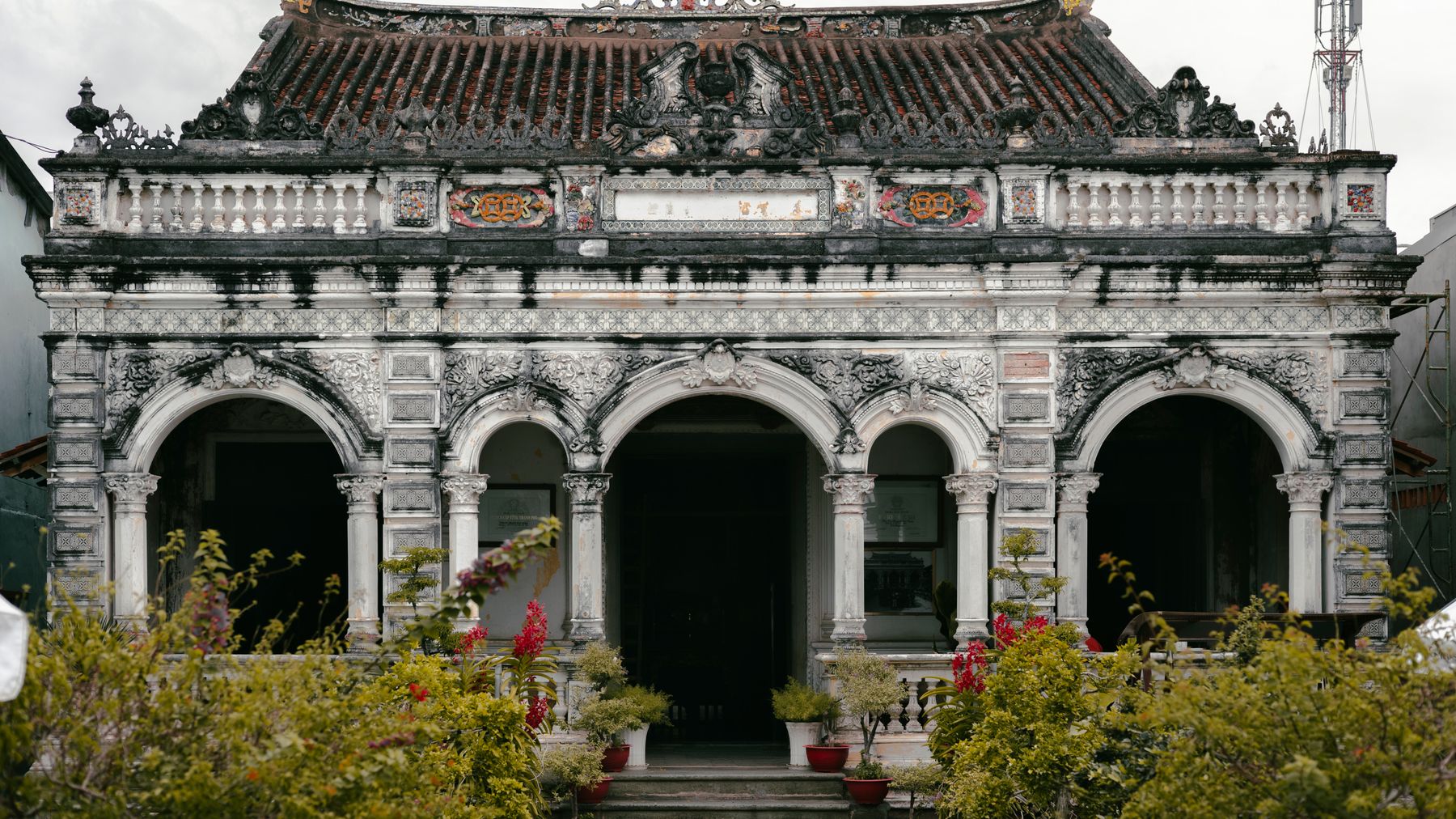
Photo by DUYTRG TRUONG on Pexels
Practical tips locals would tell you
- Bring your own water. There's no cafe or drink vendor inside the palace grounds.
- The site takes 30–45 minutes for most visitors. Don't build a half-day around it.
- Photography is allowed inside, including the murals. No flash, and tripods may get a polite "no" from staff.
- If you're also visiting the Citadel and royal tombs, check whether the combined heritage ticket (available at the Citadel ticket office) includes Cung An Dinh — it sometimes does, sometimes doesn't, depending on the current ticketing arrangement.
- Vietnamese coffee from the small cafes on Phan Dinh Phung street is a good pre- or post-visit ritual. Hue's cafe culture is quieter than Hanoi or Saigon, but the drip coffee is just as strong.
Common mistakes to avoid
- Skipping it because it's not on the main tourist loop. It's a 20-minute detour. The architecture alone justifies the stop.
- Showing up at noon. The midday closure is inconsistent, and even when they're open, the interior heats up. Morning is better.
- Confusing it with the Imperial Citadel. Cung An Dinh is a separate site on the south bank, not inside the Citadel walls. Different ticket, different location.
Practical notes
Cung An Dinh won't be the highlight of a Hue trip — the Citadel and tombs carry more weight. But it's one of the few royal sites in Hue where you can stand in a room and feel something close to how the last royals actually lived, in a building that looked more toward Paris than Beijing. For a short detour off the main route, it delivers.
Last updated · May 29, 2026 · independently researched, never sponsored.